3 aug 2023

Crossing the line on sea


In filmmaking, the 180-degree rule[1] is a basic guideline regarding the on-screen spatial relationship between a character and another character or object within a scene. The rule states that the camera should be kept on one side of an imaginary axis between two characters, so that the first character is always frame right of the second character. Moving the camera over the axis is called jumping the line or crossing the line; breaking the 180-degree rule by shooting on all sides is known as shooting in the round. 


The Foley-artist (2)


What is now called Foley originated as adding sounds to live broadcasts of radio drama from radio studios around the world in the early 1920s. Phonograph recordings of the era were not of sufficient quality or flexibility to faithfully reproduce most sound effects on cue, so a sound effects person had to create all sounds for radio plays live. Jack Donovan Foley[4] started working with Universal Studios in 1914 during the silent movie era.


2 aug 2023

Expose


A roadshow theatrical release or reserved seat engagement is the practice of opening a film in a limited number of theaters in major cities for a specific period of time before the wide release of the film. Roadshows would generally mimic a live theatre production, with an upscale atmosphere as well as somewhat higher prices than during a wide release. They were commonly used to promote major films from the 1920s–60s and build excitement. 


1 aug 2023

Nipper the famous dog


His Master's Voice (HMV) was the name of a major British record label created in 1901 by The Gramophone Co. Ltd. The phrase was coined in the late 1890s from the title of a painting by English artist Francis Barraud, which depicted a dog named Nipper listening to a wind-up disc gramophone and tilting his head. In the original, unmodified 1898 painting, the dog was listening to a cylinder phonograph. The painting was also famously used as the trademark and logo of the Victor Talking Machine Company, later known as RCA Victor. 

The painting was originally offered to James Hough, manager of Edison-Bell in London, but he declined, saying "dogs don't listen to phonographs". Barraud subsequently visited The Gramophone Co. of Maiden Lane in London where the manager William Barry Owen offered to purchase the painting if it were revised to depict their latest Improved Gramophone model. Barraud obliged, and Owen bought the painting from Barraud for £100. 


24 jul 2023

Design: Piet-Hein Eek


The applied arts are all the arts that apply design and decoration to everyday and essentially practical objects in order to make them aesthetically pleasing.[1] The term is used in distinction to the fine arts, which are those that produce objects with no practical use, whose only purpose is to be beautiful or stimulate the intellect in some way. In practice, the two often overlap. Applied arts largely overlap with decorative arts, and the modern making of applied art is usually called design.


23 jul 2023

Agricultural colonies: "pauper paradise"


These cultural landscapes demonstrate an innovative, highly influential 19th-century model of pauper relief and of settler colonialism, which today is known as an agricultural domestic colony. The property encompasses Colonies of Benevolence in three component parts: Frederiksoord-Wilhelminaoord and Veenhuizen in the Netherlands. Together they bear witness to a 19th century experiment in social reform, an effort to alleviate urban poverty by establishing agricultural colonies in remote locations. Established in 1818, Frederiksoord (the Netherlands) is the earliest of these Colonies and home to the original headquarters of the Society of Benevolence, an association which aimed to reduce poverty at the national level. The other component parts were constructed between 1820 and 1823. In Frederiksoord-Wilhelminaoord, small farms along planted avenues were built for families and this Colony was referred to as ‘free’. In Veenhuizen large dormitory structures and larger centralized farms along planted avenues were built for orphans, beggars and vagrants that worked under the supervision of guards. This colony was called ‘unfree’. Each component part has a distinctive spatial character, connected to the target group for which it was built, and a specific organization of the work, with either family farms or institutions with working farms for groups of individuals. At their peak in the mid-19th century, over 11,000 people lived in such Colonies in the Netherlands.

21 jul 2023

Korean Mix


The cinema of South Korea refers to the film industry of South Korea from 1945 to present. South Korean films have been heavily influenced by such events and forces as the Japanese occupation of Korea, the Korean War, government censorship, the business sector, globalization, and the democratization of South Korea. Though filmmakers were still subject to government censorship, South Korea experienced a golden age of cinema, mostly consisting of melodramas, starting in the mid-1950s. The number of films made in South Korea increased from only 15 in 1954 to 111 in 1959.


18 jul 2023

Fantasy movie


While some experimental films have been distributed through mainstream channels or even made within commercial studios, the vast majority have been produced on very low budgets with a minimal crew or a single person and are either self-financed or supported through small grants. Experimental filmmakers generally begin as amateurs, and some use experimental films as a springboard into commercial film-making or transition into academic positions. The aim of experimental filmmaking may be to render the personal vision of an artist, or to promote interest in new technology rather than to entertain or to generate revenue, as is the case with commercial films. 


17 jul 2023

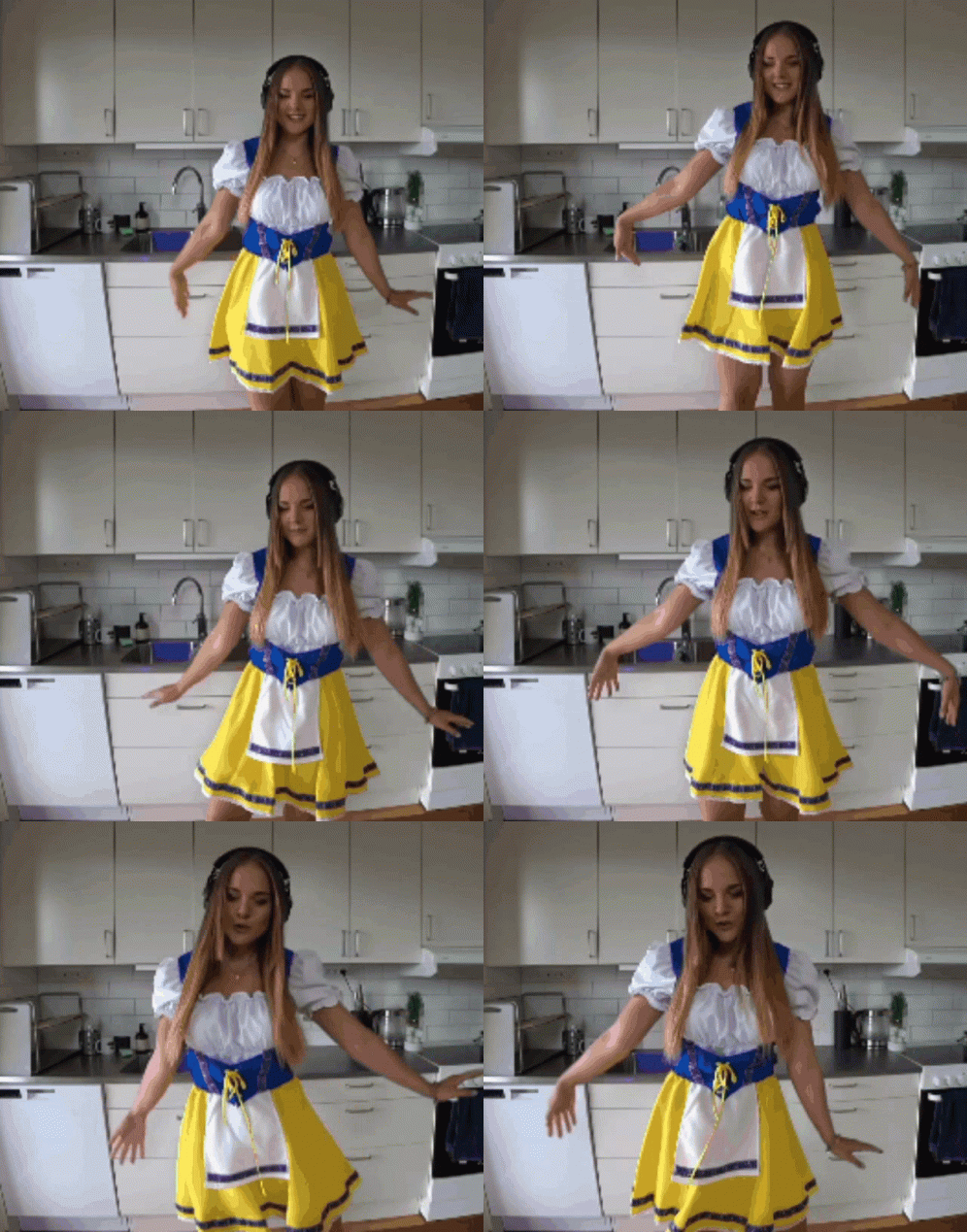
Dance show


Dance has become a popular form of content across many social media platforms, including TikTok. During 2020, TikTok dances offered the opportunity for isolated individuals to interact and connect with one another through a virtual format. Since its debut in 2017, the app has also attracted a small but growing audience of professional dancers in their early 20s to 30s. While the majority of this demographic is more accustomed to performing onstage, this app introduced a new means to generate professional exposure. 


14 jul 2023

Visit to Sweden


As early as 1906, various film entrepreneurs began to discuss the potential of home viewing of films, and in 1912, both Edison and Pathé started selling film projectors for home use. Because making release prints was (and still is) very expensive early home projector owners rented films by mail from the projector manufacturer. Edison's business model was fundamentally flawed because the company had started with phonographs and did not understand that home viewing is fundamentally different from home listening. Edison ended its home viewing business in 1914, while Pathé remained somewhat longer, but exited at some point during World War.

13 jul 2023

Capital of Sweden


The Swedish Film Institute was founded in 1963 to support and develop the Swedish film industry. It supports Swedish filmmakings and allocates grants for production, distribution and public showing of Swedish films in their native country. It also promotes Swedish cinema internationally. Furthermore, the Institute organizes the annual Guldbagge Awards. Through the Swedish Film Agreement, between the Swedish state and the film and media industry, the Government of Sweden, the TV companies which are party to the agreement, and Sweden's cinema owners jointly fund the Film Institute and thus, indirectly, Swedish filmmaking. The agreement usually runs for five years, and due for renewal from 1 January of the next year after expiration. 

At a rate of about 20 films a year the Swedish film industry is on par with other comparable North European countries. In Trollhättan Municipality there is a film production facility known as Trollywood; movies shot there include Show Me Love, Dancer in the Dark and Dogville. The movie studio Film i Väst centered here produces about half of Sweden's full-length films.


12 jul 2023

Veronica :pirate radio ship


Transmission of radio and television programs from a radio or television station to home receivers by radio waves is referred to as "over the air" (OTA) or terrestrial broadcasting and in most countries requires a broadcasting license. Transmissions using a wire or cable, like cable television (which also retransmits OTA stations with their consent), are also considered broadcasts but do not necessarily require a license (though in some countries, a license is required). In the 2000s, transmissions of television and radio programs via streaming digital technology have increasingly been referred to as broadcasting as well.


10 jul 2023

Gif movies movements


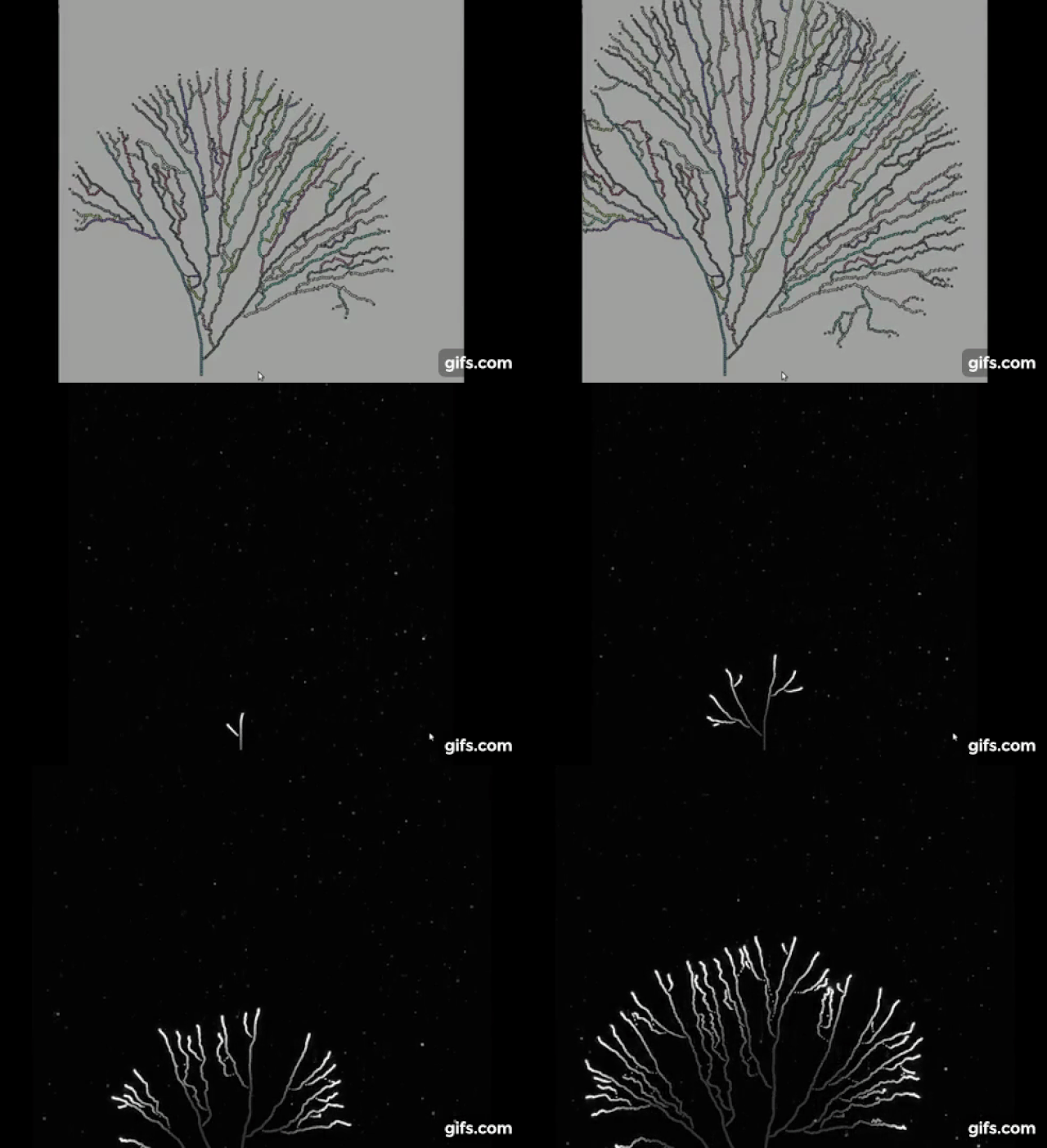
GIFs are suitable for sharp-edged line art with a limited number of colors, such as logos. This takes advantage of the format's lossless compression, which favors flat areas of uniform color with well defined edges.,They can also be used to store low-color sprite data for games. GIFs can be used for small animations and low-resolution video clips, or as reactions in online messaging used to convey emotion and feelings instead of using words. They are popular on social media platforms such as Tumblr, Facebook and Twitter. Videos resolve many issues that GIFs present through common usage on the web. They include drastically smaller file sizes, the ability to surpass the 8-bit color restriction, and better frame-handling and compression through codecs. Virtually universal support for the GIF format in web browsers and a lack of official support for video in the HTML standard caused GIF to rise to prominence for the purpose of displaying short video-like files on the web. 


ALIVE


 Live action (or live-action) is a form of cinematography or videography that uses photography instead of animation. Some works combine live-action with animation to create a live-action animated film. Live-action is used to define film, video games or similar visual media. 

Livestreaming is streaming media simultaneously recorded and broadcast over the internet in real-time or near real-time. It is often referred to simply as streaming. Non-live media such as video-on-demand, vlogs, and YouTube videos are technically streamed, but not live-streamed.


9 jul 2023

Handmade cheese


Open Archief is a multifaceted, collaborative research project that explores the beauty and innovation that can be inspired by making archival material accessible to artists for creative reuse. Brought forward by three Dutch heritage institutions: Het Nieuwe Instituut, Sound & Vision, and the International Institute of Social History


Graphic design in film


In recent years, the role of graphic design in film has become more established, with more and more directors recognising the importance visual artists play in bringing their visions to life. That said, graphic design in film still remains, for some reason, an underrated and unpopular career path. But why is that? Is it too competitive? Too reliant on connections? Impossible to find a way in?  To be honest, creating graphic design in film or television is a thankless one. It’s great for producers and directors to have graphic designers around because sourcing and using real products from actual brands would be a logistical nightmare (not to mention expensive), but if a designer is doing his/her job well, the average viewer won’t be able to tell that a job was done at all, or that it was done several times over


8 jul 2023

Timber building material


A flashforward (also spelled flash-forward, and more formally known as prolepsis) is a scene that temporarily takes the narrative forward in time from the current point of the story in literature, film, television and other media. Flashforwards are often used to represent events expected, projected, or imagined to occur in the future. They may also reveal significant parts of the story that have not yet occurred, but soon will in greater detail. It is similar to foreshadowing, in which future events are not shown but rather implicitly hinted at. It is also similar to an ellipsis, which takes the narrative forward and is intended to skim over boring or uninteresting details, for example the aging of a character. It is primarily a postmodern narrative device, named by analogy to the more traditional flashback, which reveals events that occurred in the past. 


7 jul 2023

Pastorale


Melodrama films are a subgenre of drama films characterized by plots that appeal to the heightened emotions of the audience. Melodramatic films commonly use plots that involve crises of human emotion, failed romance or friendship, strained familial situations, tragedy, illness, neuroses, or emotional and physical hardship. The stock characters present in melodrama films include victims, couples, virtuous and heroic characters, and suffering protagonists (usually heroines). These characters are faced with tremendous social pressures, threats, repression, fears, improbable events or difficulties with friends, community, work, lovers, or family. Following the typical melodramatic format, the characters work through their difficulties and surmount the problems. A common point of plot tension sees characters feeling trapped by the typical melodramatic settings of the domestic sphere of the home or small town. Filmmakers often add flashbacks to expand the otherwise constant settings of melodramatic films.

6 jul 2023

Recollected amateurfilms


The film Paradise Recollected is compiled out of archive material from The International Institute for the Conservation, Archiving and Distribution of Other people’s Memories. This archive consists mainly of found 8mm films, sourced from flea markets and garage sales. These are amateur films, travelogues and family documents whose main purpose is to remember certain occasions.


Living Building Materials


Live action (or live-action) is a form of cinematography or videography that uses photography instead of animation. Some works combine live-action with animation to create a live-action animated film. Live-action is used to define film, video games or similar visual media. Photorealistic animation, particularly modern computer animation, is sometimes erroneously described as "live-action" In producing a movie, both live-action and animation present their own pros and cons. Unlike animation, live-action involves the photography of actors and actresses, as well as sets and props making the movie seem personal and as close to reality as possible. The only drawback is one's budget. On the other hand, animation works well in conveying abstract ideas but it generally takes much longer to produce