15 aug 2018

Making of in Bamberg


In filmmaking and video production, footage is raw, unedited material as originally filmed by a movie camera or recorded by a video camera, which typically must be edited to create a motion picture, video clip, television show or similar completed work.

Footage may also refer to sequences used in film and video editing, such as special effects and archive material (for special cases of this, see stock footage and B roll).

Since the term originates in film, footage is only used for recorded images, such as film stock, videotapes or digitized clips – on live television, the signals from video cameras are instead called sources.


Back home


Pigeon photography is an aerial photography technique invented in 1907 by the German apothecary Julius Neubronner, who also used pigeons to deliver medications. A homing pigeon was fitted with an aluminium breast harness to which a lightweight time-delayed miniature camera could be attached. Neubronner's German patent application was initially rejected, but was granted in December 1908 after he produced authenticated photographs taken by his pigeons. He publicized the technique at the 1909 Dresden International Photographic Exhibition, and sold some images as postcards at the Frankfurt International Aviation Exhibition and at the 1910 and 1911 Paris Air Shows.


14 aug 2018

Chinese pavillion in Mannheim Germany


It takes a lot of energy to shoot a travel documentary. There are many things to worry about.The production process of travel documentaries is very complicated. First, the director needs to place a large number of staff and allocate all the equipment. In addition, they have to be responsible for formulating travel plans. They also need to book hotels and foods in advance. And they may have to prepare for many unexpected situations.

The documentary filming method is different from many other films. In the process of documentary filming, it is often necessary to interview other people. So the quality of the interview is very important for the documentary.In addition, the details of the documentary are also very important.Take tourism documentaries as an example. Only by making every appealing place in the tourist destination clear, can we attract more people to travel there.There are also some questions about the shooting angle. Because documentaries have a higher requirement for authenticity, they must have the most reasonable shooting angle.


Loading


In media and advertising, nostalgia-evoking images, sounds, and references can be used strategically to create a sense of connectedness between consumers and products with the goal of convincing the public to consume, watch, or buy advertised products. Modern technology facilitates nostalgia-eliciting advertising through the subject, style, and design of an advertisement. The feeling of longing for the past is easily communicated through social media and advertising because these media require the participation of multiple senses, are able to represent their ideas entirely, and therefore become more reminiscent of reality.


2 aug 2018

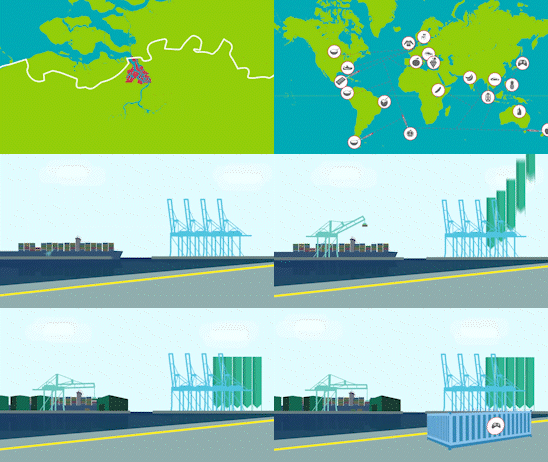
The strugle of the Scheldt


A documentary film is a nonfictional motion picture intended to document some aspect of reality, primarily for the purposes of instruction, education, or maintaining a historical record.[1] Such films were originally shot on film stock—the only medium available—but now include video and digital productions that can be either direct-to-video, made into a TV show, or released for screening in cinemas. "Documentary" has been described as a "filmmaking practice, a cinematic tradition, and mode of audience reception" that is continually evolving and is without clear boundaries


1 aug 2018

The Idea: The Seventh Seal

The Seventh Seal is a 1957 Swedish epic historical fantasy film written and directed by Ingmar Bergman. Set in Denmark during the Black Death, it tells of the journey of a medieval knight and a game of chess he plays with the personification of Death , who has come to take his life.
Bergman developed the film from his own play Wood Painting. The title refers to a passage from the Book of Revelation, used both at the very start of the film, and again towards the end, beginning with the words "And when the Lamb had opened the seventh seal, there was silence in heaven about the space of half an hour". Here the motif of silence refers to the "silence of God," which is a major theme of the film.


22 jul 2018

Japanese Garden: Hasselt


A step outline (more commonly called a beat sheet) is a detailed telling of a story with the intention of turning the story into a screenplay for a motion picture.

The step outline briefly details every scene of the screenplay's story, and often has indications for dialog and character interactions. The scenes are often numbered for convenience.

It can also be an extremely useful tool for a writer working on a spec script.


19 jul 2018

Basketweirfishtrap


A weir may be used to trap marine fish in the intertidal zone as the tide recedes, fish such as salmon as they attempt to swim upstream to breed in a river, or eels as they migrate downstream. Alternatively, fish weirs can be used to channel fish to a particular location, such as to a fish ladder. Weirs were traditionally built from wood or stones. The use of fishing weirs as fish traps probably dates back prior to the emergence of modern humans, and have since been used by many societies across the world.
In medieval Europe, large fishing weir structures were constructed from wood posts and wattle fences. V-shaped structures in rivers could be as long as 60 m and worked by directing fish towards fish traps or nets. Such weirs were frequently the cause of disputes between various classes of river users and tenants of neighbouring land. Basket weir fish traps are shown in medieval illustrations and surviving examples have been found. Basket weirs are about two metres long and comprise two wicker cones, one inside the other — easy for fish to get into but difficult to escape.


16 jul 2018

A Ceasar Bridge


The term historical period drama (also historical drama, period drama, costume drama, and period piece) refers to a work set in a past time period, usually used in the context of film and television. It is an informal crossover term that can apply to several genres and is often heard in the context of historical fiction and romances, adventure films, and swashbucklers. A period piece may be set in a vague or general era such as the Middle Ages or a specific period such as the Roaring Twenties. A religious work can qualify as period drama but not as historical drama.


The historical period drama is a film genre in which stories are based upon historical events and famous people. Some historical dramas are docudramas, which attempt an accurate portrayal of a historical event or biography, to the degree that the available historical research will allow.


Anyone Can Buy (a Seat at the Cinema)

Video poetry is a wide-ranging category where very different typologies of works converge. Some video poetry works use digital elaboration to achieve Digital poetry that is entirely generated by software. When absent of digital effects, video poetry is akin to performance works or a poetry reading recorded in video (digital or analogue) but goes beyond the straightforward act of recording to establish a link with video art. In this sense, video poetry is a particular form of video art comprising poetry texts elaborated at various acoustic and visual levels

Maggie Clark: As my focus is primarily in documentary, the film poem has been an opportunity for me to expand my creative practice and be a little bit more playful with the way I film. It’s pushed me to use visual metaphor as a storytelling device, which is a challenge I’ve really enjoyed! Laura’s poem is about love in the face of prejudice. It carries a sincere and important message, which I hope to do justice in my film.

Laura Seymour: When Maggie and I were talking at the start of the project, I saw that one or two images in the poem stuck out visually from the rest, and also that the images that stuck out visually were perhaps the most ambiguous. The idea that readers or watchers might be more affected by ambivalent imagery was really interesting to me.