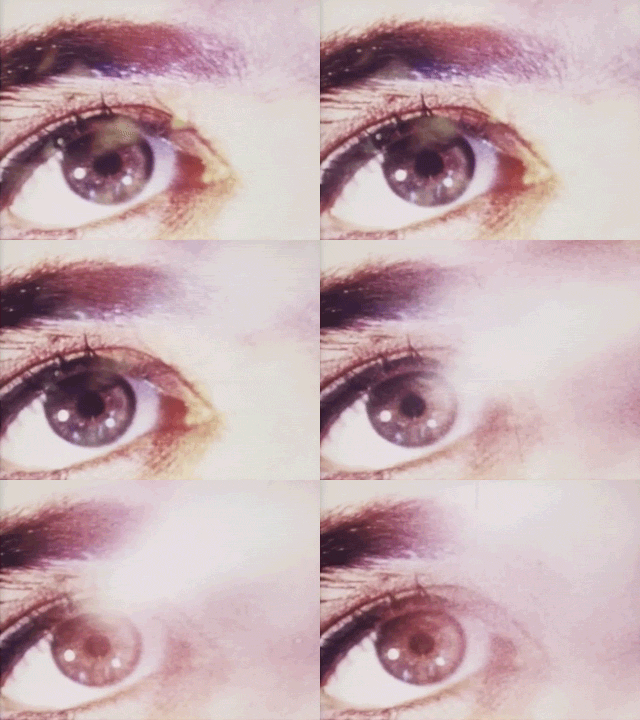
When applied to the cinema, mise-en-scène refers to everything that appears before the camera—the sets, props, costumes, actors, and even the lighting. These elements help to express a film's vision by generating a sense of time and space, as well as setting a mood. Mise-en-scène can be used to suggest a character's state of mind, whether that be happy with bright colors, or sad with darker colors. Mise-en-scène also includes the composition, which consists of the positioning and movement of actors, as well as objects, in the shot, as overseen by the director and production designer. The director, cast, and crew (who control props, costumes, lighting and sound) all have input on the mise-en-scène; they work together to make sure it fits the film well before production begins.
12 apr 2024
Typical Bergen op Zoom
11 apr 2024
City Palace (Bergen op Zoom)
Post-production This stage is usually thought of as starting when principal photography ends, but they may overlap. The bulk of post-production consists of the film editor reviewing the footage with the director and assembling the film out of selected takes. The production sound (dialogue) is also edited; music tracks and songs are composed and recorded if a film is intended to have a score; sound effects are designed and recorded. Any computer-generated visual effects are digitally added by an artist. Finally, all sound elements are mixed down into "stems", which are synchronized to the images on the screen, and the film is fully completed ("locked").
10 apr 2024
Cargo
Most films use either a casting agency or a casting director to find actors to match the roles in the film, apart from the lead actors, who are often chosen by directors and producers. The job of a casting director is to know a lot about a lot of actors, so that they can advise and present to the director the best of the available talent. Casting directors are highly influential and are usually on the project because the director trusts their judgement; they are also the ones who decide who the director does see.
8 apr 2024
Monsters
Collage film is a style of film created by juxtaposing found footage from disparate sources (archival footage, excerpts from other films, newsreels, home movies, etc.). The term has also been applied to the physical collaging of materials onto film stock.
Oldest Dutch Hotel
Direct-to-video or straight-to-video refers to the release of a film, television series, short or special to the public immediately on home video formats rather than an initial theatrical release or television premiere. This distribution strategy was prevalent before streaming platforms came to dominate the TV and movie distribution markets.
7 apr 2024
Crowdfunding
In motion picture and television production, a sound effect is a sound recorded and presented to make a specific storytelling or creative point, without the use of dialogue or music. The term often refers to a process, applied to a recording, without necessarily referring to the recording itself. In professional motion picture and television production, the segregations between recordings of dialogue, music, and sound effects can be quite distinct, and it is important to understand that in such contexts, dialogue, and music recordings are never referred to as sound effects, though the processes applied to them, such as reverberation or flanging, often are.
Bully is Bad
In the performing arts industry such as theatre, film, or television, casting, or a casting call, is a pre-production process for selecting a certain type of actor, dancer, singer, or extra for a particular role or part in a script, screenplay, or teleplay. This process may be used for a motion picture, television program, documentary film, music video, play, or advertisement, intended for an audience.
6 apr 2024
Hobby: super 8 mm film
8 mm film is a motion picture film format in which the film strip is eight millimetres (0.31 in) wide. It exists in two main versions – the original standard 8 mm film, also known as regular 8 mm, and Super 8. Although both standard 8 mm and Super 8 are 8 mm wide, Super 8 has a larger image area because of its smaller and more widely spaced perforations. There are also two other varieties of Super 8 – Single 8 mm and Straight-8 – that require different cameras but produce a final film with the same dimensions.
2 apr 2024
Beach Belief
The growing popularity and availability of non-linear editing systems has allowed film-makers and any user of film to shoot Super 8 film but edit in digital. This avoids much of the tedium of handling film and the damage to the film, which can occur when editing the actual film.[original research?] Super 8 films may be transferred (scanned) to digital and then imported into computer-based editing and correction systems for post production. Today's systems can scan Super 8 to 4K digital in a variety of formats.
Miss Match
Amateur films were usually shot on 16 mm film or on 8 mm film (either Double-8 or Super-8) until the advent of cheap video cameras or digital equipment. The advent of digital video and computer based editing programs greatly expanded the technical quality achievable by the amateur and low-budget filmmaker. Amateur video has become the choice for the low-budget filmmaker and has boomed into a very watched and even produced industry with the use of VHS and digital video camcorders.
1 apr 2024
Flower auction
If Aalsmeer is the beating heart of the international flower trade, then Royal FloraHolland is the main vein. It is the largest marketplace for flowers and plants in the world. You have to get up early to visit this world-famous flower auction in Aalsmeer, but the reward is an unforgettable experience. The earlier you get there, the more you see.
Media Literacy
Media literacy is an expanded conceptualization of literacy that includes the ability to access and analyze media messages as well as create, reflect and take action, using the power of information and communication to make a difference in the world. Media literacy is not restricted to one medium and is understood as a set of competencies that are essential for work, life, and citizenship. Media literacy education is the process used to advance media literacy competencies, and it is intended to promote awareness of media influence and create an active stance towards both consuming and creating media. Media literacy education is part of the curriculum in the United States and some European Union countries, and an interdisciplinary global community of media scholars and educators engages in knowledge and scholarly and professional journals and national membership associations..
26 mrt 2024
Director: Agnes Varda
Filmmaking career: Varda's filmmaking career predates the French New Wave, but contains many elements specific to that movement. While working as a photographer, Varda became interested in making a film, although she stated that she knew little about the medium and had only seen around 20 films by the age of 25. She later said that she wrote her first screenplay "just the way a person writes his first book. When I'd finished writing it, I thought to myself: 'I'd like to shoot that script,' and so some friends and I formed a cooperative to make it." She found the filmmaking process difficult because it did not allow the same freedom as writing a novel; she said her approach was instinctive and feminine. In an interview with The Believer, Varda said that she wanted to make films that related to her time , rather than focusing on traditions or classical standards.
25 mrt 2024
Amsterdam:High/Low
Before crewed flight was common, the term "bird's eye" was used to distinguish views drawn from direct observation at high vantage locations (e.g. a mountain or tower), from those constructed from an imagined bird's perspectives. Bird's eye views as a genre have existed since classical times. They were significantly popular in the mid-to-late 19th century in the United States and Europe as photographic prints.
In cinematography, a low-angle shot, is a shot from a camera angle positioned low on the vertical axis, anywhere below the eye line, looking up.Sometimes, it is even directly below the subject's feet. Psychologically, the effect of the low-angle shot is that it makes the subject look strong and powerful.
24 mrt 2024
Scotland scenes
Creativity and Style: Your unique perspective distinguishes your work. Cinematic quality isn’t about perfection but about storytelling that resonates. Combining footage, music, editing, and captions crafts your cinematic narrative.
23 mrt 2024
Darkrooms vertical
We are all influenced by nature. Every day. Even our minds depend on it. But nature is beginning to disappear from our world bit by bit. Concrete is taking its place and displays are creating a longing for a substitute nature: "The perfect sunset" or "a sparkling sunbeam hitting the surface of the water." The exhibition is a journey around the world! The works were created all over the world: Mexico City, Sydney, New York, Milan, Madrid, Amsterdam and Zurich. In collaboration with 12 international artists, sound and light installations have been created in the 120-year-old tower, creating their own weather system. The artworks react to each other. No two installations are ever the same. All guests enter the exhibition through a black lock. This darkness serves an important purpose: it cleanses our senses of chaotic everyday impressions.
20 mrt 2024
Bizarrely Movie
New media art includes artworks designed and produced by means of electronic media technologies. It comprises virtual art, computer graphics, computer animation, digital art, interactive art, sound art, Internet art, video games, robotics, 3D printing, immersive installation and cyborg art. The term defines itself by the thereby created artwork, which differentiates itself from that deriving from conventional visual arts such as architecture, painting or sculpture.
18 mrt 2024
Filmmaker/artist: Isaac Julien
One of the objectives of Julien's work is to break down the barriers that exist between different artistic disciplines, drawing from and commenting on film, dance, photography, music, theatre, painting and sculpture, and uniting these to construct a powerfully visual narrative. Thematically, much of his work directly relates to experiences of black and gay identity (he is himself gay), including issues of class, sexuality, and artistic and cultural history. Julien is a documentary filmmaker, and his work in this genre includes BaadAsssss Cinema, a film on the history and influence of blaxploitation cinema.
17 mrt 2024
Shooting footage
In intentional camera movement (ICM), a camera is moved during the exposure for a creative or artistic effect. In a sense, ICM is the same effect as (intentional) single-exposition motion blur: in the former the camera moves during exposure, in the second the target moves, but they have in common that there is relative motion between camera and target, often resulting in streaking in the image. Yet, the definitions are better left vague as freedom and creativity is especially relevant to this process.
A special case, called panning, occurs when the camera is moved during exposure while keeping it pointed at a moving target, to hold its projection on the recording medium steady. The stationary environment (usually mainly background, but possibly also some foreground) then is subjected to ICM and appears streaked in the final image. Another special case is that of forward (or backwards) camera movement, typically with the camera focused on the distance. The streaks in the resulting image converge on the central point, giving a suggestion as if it is at the end of a long tunnel. A similar effect can be achieved by changing the focal length of a zoom lens during the exposure.
16 mrt 2024
Fairground
Continuity editing uses a guideline called the "30-degree rule" to avoid the appearance of jump cuts. The 30-degree rule advises that for consecutive shots to appear seamless and continuous in time, the camera position must vary at least 30 degrees from its previous position. Some schools would call for a change in framing as well (e.g., from a medium shot to a close up). The idea is to convey to the viewer a different point of view on the action but with the timeline of the action being continuous. Generally, if the camera position changes less than 30 degrees, the difference between the two shots is not substantial enough, and the viewer experiences the edit as a jump in the position of the subject rather than a change of point of view, which is jarring.