In 1937, in one of the worst civilian casualties of the Spanish Civil War, Fascist forces bombed the village of Guernica in Northern Spain. For Pablo Picasso, the tragedy sparked a frenzied period of work in which he produced a massive anti-war mural, titled "Guernica." How can we make sense of this overwhelming image, and what makes it a masterpiece of anti-war art? Iseult Gillespie investigates. [Directed by Avi Ofer, narrated by Adrian Dannatt, music by Marcos Tawil].
6 jul 2019
Shocking Picture
In 1937, in one of the worst civilian casualties of the Spanish Civil War, Fascist forces bombed the village of Guernica in Northern Spain. For Pablo Picasso, the tragedy sparked a frenzied period of work in which he produced a massive anti-war mural, titled "Guernica." How can we make sense of this overwhelming image, and what makes it a masterpiece of anti-war art? Iseult Gillespie investigates. [Directed by Avi Ofer, narrated by Adrian Dannatt, music by Marcos Tawil].
5 jul 2019
Souvenirs de le Puy
Cinephilia (/ˌsɪnɪˈfɪliə/; also cinemaphilia or filmophilia) is the term used to refer to a passionate interest in films, film theory, and film criticism. The term is a portmanteau of the words cinema and philia, one of the four ancient Greek words for love. A person with a passionate interest in cinema is called a cinephile (/ˈsɪnɪfaɪl/), cinemaphile, filmophile, or, informally, a film buff (also movie buff).
In English, "cinephile" is sometimes used interchangeably with the word cineaste (/ˈsɪniæst, ˈsɪneɪæst/), though in the original French the term cinéaste ([sineast]) refers to a cinephile who is also a filmmaker.
3 jul 2019
In Dutch
Director, Charles Nichols; story, Harry Reeves, Jess Marsh; animation, George Nichols, Marvin Woodward, Gerry Hathcock, Brad Case; music, Oliver Wallace
Holland is saved from a watery disaster in this Walt Disney-animated folktale. When Pluto attempts to impress Dinah Dachshund, he sets off a false alarm. On their way out of town the two banished dogs spot a real hole in the dike. Dinah bravely sticks her paw in the hole while Pluto tries a succession of zany antics to arouse the doubtful townsfolk
Herring
Vlaggetjesdag (“flag day”) has celebrated the arrival of the first herring (“Hollandse Nieuwe”) in the southern coastal towns of Vlaardingen and Scheveningen for years. Hundreds of thousands of people gather in Scheveningen for the festivities, and the fishing boats are decorated especially for the occasion. In addition to the omnipresent herring, this day also features a number of activities unrelated to fish, for both young and old. In Scheveningen, the first barrel of herring is traditionally sold at an auction on the Thursday preceding the official Vlaggetjesdag Scheveningen, and the proceeds go to charity.
2 jul 2019
Memories of France
The road movie keeps its characters "on the move", and as such the "car, the tracking shot, [and] wide and wild open space" are important iconography elements, similar to a Western movie. As well, the road movie is similar to a Western in that road films are also about a "frontiersmanship" and about the codes of discovery (often self-discovery) Road movies often use the music from the car stereo, which the characters are listening to, as the soundtrack.
20 jun 2019
Citadel in Images
French inventor Henri Chrétien developed and patented a new film process that he called Anamorphoscope in 1926. It was this process that would later form the basis for CinemaScope. Chrétien's process was based on lenses that employed an optical trick which produced an image twice as wide as those that were being produced with conventional lenses; this was done using an optical system called Hypergonar, which was the process of compressing (at shoot time) and dilating (at projection time) the image laterally. He attempted to interest the motion picture industry in his invention, but at that time the industry was not sufficiently impressed.
By 1950, however, cinema attendance seriously declined with the advent of a new competitive rival: television.
19 jun 2019
Basilica in Vezelay
In filmmaking and video production, a shot is a series of frames that runs for an uninterrupted period of time. Film shots are an essential aspect of a movie where angles, transitions and cuts are used to further express emotion, ideas and movement. The term "shot" can refer to two different parts of the filmmaking process:
In production, a shot is the moment that the camera starts rolling until the moment it stops.
In film editing, a shot is the continuous footage or sequence between two edits or cuts.
18 jun 2019
"Coronation street" (riots)
The Amsterdam coronation riots (Dutch: Kroningsoproer) refers to major violence and rioting in Amsterdam, the Netherlands on the day of the coronation of Queen Beatrix, 30 April 1980. It was the biggest episode of such disturbances in the country since the end of World War II and the most significant event of the Dutch squatters' movement (Krakersrellen).
Beatrix's coronation as Queen was on 30 April 1980, and was when squatters started to riot. The protesters were rallying under the slogan Geen woning, geen kroning, which translates to 'No house, no coronation'. Despite the presence of 10,000 police officers, gendarmes and some military officers, the event turned into a major clash. The riots were centred around the Dam Square, where the new Queen's inauguration took place. Clashes also happened in and around Blauwbrug, Rokin and Vondelstraat.
It marked a milestone in the post-war peaceful history of the Netherlands. 600 people were wounded.[
Train to the citadel
Traditionally, films were recorded onto celluloid film through a photochemical process and then shown through a movie projector onto a large screen. Contemporary films are often fully digital through the entire process of production, distribution, and exhibition, while films recorded in a photochemical form traditionally included an analogous optical soundtrack (a graphic recording of the spoken words, music and other sounds that accompany the images which runs along a portion of the film exclusively reserved for it, and is not projected).
Films are cultural artifacts created by specific cultures. They reflect those cultures, and, in turn, affect them. Film is considered to be an important art form, a source of popular entertainment, and a powerful medium for educating—or indoctrinating—citizens. The visual basis of film gives it a universal power of communication.
17 jun 2019
Another day in Grenoble
The name "film" originates from the fact that photographic film (also called film stock) has historically been the medium for recording and displaying motion pictures. Many other terms exist for an individual motion-picture, including picture, picture show, moving picture, photoplay, and flick. The most common term in the United States is movie, while in Europe film is preferred. Common terms for the field in general include the big screen, the silver screen, the movies, and cinema; the last of these is commonly used, as an overarching term, in scholarly texts and critical essays. In early years, the word sheet was sometimes used instead of screen.
14 jun 2019
Jan Bont en Ed van der Elsken
De Bont was born in Eindhoven, Netherlands.
His earliest work after studying at the Amsterdam Film Academy was with the Dutch avant garde director Adriaan Ditvoorst. He first came known in the Netherlands as the cinematographer for the infamous 1971 film Blue Movie followed by the 1973 film Turkish Delight, directed by Paul Verhoeven, starring Rutger Hauer and Monique van de Ven. Since the early 1980s, he worked frequently in Hollywood, often collaborating with directors including Verhoeven and John McTiernan.
De Bont made his directorial debut with the action thriller Speed in 1994, which was a surprise hit
More video on Ed van der Elsken on this very website .
Grenoble
Although usually more expensive than film projectors, high-resolution digital projectors offer many advantages over traditional film units. For example, digital projectors contain no moving parts except fans, can be operated remotely, are relatively compact and have no film to break, scratch or change reels of. They also allow for much easier, less expensive, and more reliable storage and distribution of content. All-electronic distribution eliminates all physical media shipments. There is also the ability to display live broadcasts in theaters so equipped.
13 jun 2019
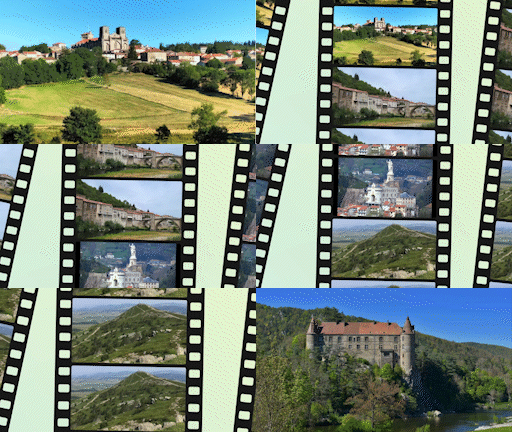
Images from le Puy en Velay
Images may be two-dimensional, such as a photograph or screen display, or three-dimensional, such as a statue or hologram. They may be captured by optical devices – such as cameras, mirrors, lenses, telescopes, microscopes, etc. and natural objects and phenomena, such as the human eye or water.
The word 'image' is also used in the broader sense of any two-dimensional figure such as a map, a graph, a pie chart, a painting or a banner. In this wider sense, images can also be rendered manually, such as by drawing, the art of painting, carving, rendered automatically by printing or computer graphics technology, or developed by a combination of methods, especially in a pseudo-photograph.
12 jun 2019
Haute Loire
10 jun 2019
Vezelay
White balance basically means colour balance. It is a function which gives the camera a reference to "true white" — it tells the camera what the colour white looks like, so the camera will record it correctly. Since white light is the sum of all other colours, the camera will then display all colours correctly.
Incorrect white balance shows up as pictures with orange or blue tints, as demonstrated by the following examples:
Most consumer-level camcorders have an "auto-white balance" feature, and this is how most amateurs operate. The camera performs it's own white balance without any input from the operator. In fact, very few home-video users are aware of it's existence. Unfortunately, the auto-white balance is not particularly reliable and it is usually preferable to perform this function manually.
Line 2 in Göteborg
Kodak ceased sales of standard 8 mm film under its own brand in the early 1990s, but continued to manufacture the film, which was sold via independent film stores. Black-and-white 8 mm film is still manufactured in the Czech Republic, and several companies buy bulk quantities of 16 mm film to make regular 8 mm by re-perforating the stock, cutting it into 25 foot (7.6 m) lengths, and collecting it into special standard 8 mm spools, which they then sell. Re-perforation requires special equipment. Some specialists also produce Super 8 mm film from existing 16 mm, or even 35 mm film stock.
9 jun 2019
Burgundy: Morvan
An open content film is much like an independent film, but it is produced through open collaborations; its source material is available under a license which is permissive enough to allow other parties to create fan fiction or derivative works, than a traditional copyright. Like independent filmmaking, open source filmmaking takes place outside Hollywood, or other major studio systems.
8 jun 2019
Grenoble from Above
The increasingly rare industry term "short subject" carries more of an assumption that the film is shown as part of a presentation along with a feature film. Short films are often screened at local, national, or international film festivals and made by independent filmmakers with either a low budget or no budget at all. They are usually funded by film grants, nonprofit organizations, sponsor, or personal funds. Short films are generally used for industry experience and as a platform to showcase talent to secure funding for future projects from private investors, a production company, or film studios.
7 jun 2019
Ardeche Mountains
White balance
On digital cameras, electronic compensation for the color temperature associated with a given set of lighting conditions, ensuring that white light is registered as such on the imaging chip and therefore that the colors in the frame will appear natural. On mechanical, film-based cameras, this function is served by the operator's choice of film stock or with color correction filters. In addition to using white balance to register natural coloration of the image, photographers may employ white balance to aesthetic end, for example, white balancing to a blue object in order to obtain a warm color temperature.
6 jun 2019
Openair cinema
Projectors can be roughly divided into three categories, based on the type of input. Some of the listed projectors were capable of projecting different types of input. For instance: video projectors were basically developed for the projection of prerecorded moving images, but are regularly used for still images in PowerPoint presentations and can easily be connected to a video camera for real-time input. The magic lantern is best known for the projection of still images, but was capable of projecting moving images from mechanical slides since its invention and was probably at its peak of popularity when used in phantasmagoria shows to project moving images of ghosts.