8 nov 2020

Fishtrap


A fishing weir, fish weir, fishgarth or kiddle is an obstruction placed in tidal waters, or wholly or partially across a river, to direct the passage of, or trap fish. A weir may be used to trap marine fish in the intertidal zone as the tide recedes, fish such as salmon as they attempt to swim upstream to breed in a river, or eels as they migrate downstream. Alternatively, fish weirs can be used to channel fish to a particular location, such as to a fish ladder. Weirs were traditionally built from wood or stones. The use of fishing weirs as fish traps probably dates back prior to the emergence of modern humans, and have since been used by many societies across the world. 


7 nov 2020

Orvelte: museum village


With the advent of digital editing in non-linear editing systems, film editors and their assistants have become responsible for many areas of filmmaking that used to be the responsibility of others. For instance, in past years, picture editors dealt only with just that—picture. Sound, music, and (more recently) visual effects editors dealt with the practicalities of other aspects of the editing process, usually under the direction of the picture editor and director. However, digital systems have increasingly put these responsibilities on the picture editor. It is common, especially on lower budget films, for the editor to sometimes cut in temporary music, mock up visual effects and add temporary sound effects or other sound replacements. These temporary elements are usually replaced with more refined final elements produced by the sound, music and visual effects teams hired to complete the picture. 


6 nov 2020

Suriname


Contexts By contexts we mean the artistic, economic, cultural, social, historical and current contexts in which the film is made and viewed. What is the concept, idea, message, vision and intention of the maker? Is the intended purpose commercial, artistic, engaging? What is the background of the maker? For which audience was the film made?


5 nov 2020

Amateurfilm


The language of film Film language is - in addition to spoken and written language - the way in which we communicate with each other in the 21st century. Film education is aimed at getting students in primary and secondary education to "speak the language of film fluently". This is very important, because film has a major influence on how we see ourselves and the world. In addition, film is a great way to tell your story and share it with the world. 


4 nov 2020

Metropolis Amsterdam


 A feature film, or feature-length film, is a film (also called a motion picture or movie) with a running time long enough to be considered the principal or sole film to fill a program. The term feature film originally referred to the main, full-length film in a cinema program that also included a short film and often a newsreel. The notion of how long a feature film should be has varied according to time and place. According to the Academy of Motion Picture Arts and Sciences, the American Film Institute and the British Film Institute,[1] a feature film runs for more than 40 minutes, while the Screen Actors Guild asserts that a feature's running time is 75 minutes or longer. 


Pauper paradise

Docufiction (or docu-fiction), often confused with docudrama, is the cinematographic combination of documentary and fiction, this term often meaning narrative film. It is a film genre which attempts to capture reality such as it is (as direct cinema or cinéma vérité) and which simultaneously introduces unreal elements or fictional situations in narrative in order to strengthen the representation of reality using some kind of artistic expression. More precisely, it is a documentary mixed with fictional elements,in real time, filmed when the events take place, and in which the main character or characters—often portrayed by non-professional or amateur actors—are essentially playing themselves, or slightly fictionalized versions of themselves, in a fictionalized scenario.


3 nov 2020

Flying Dutchmen


The multiple-camera setup, multiple-camera mode of production, multi-camera or simply multicam is a method of filmmaking and video production. Several cameras - either film or professional video cameras - are employed on the set and simultaneously record or broadcast a scene. It is often contrasted with a single-camera setup, which uses one camera. 


2 nov 2020

Fen-colony


Early documentary films, originally called "actuality films", lasted one minute or less. Over time, documentaries have evolved to become longer in length, and to include more categories; some examples being: educational, observational, and docufiction. Documentaries are very informative and are often used within schools, as a resource to teach various principles. Social-media platforms (such as YouTube) have provided an avenue for the growth of the documentary-film genre. These platforms have increased the distribution area and ease-of-accessibility; thereby enhancing the ability to educate a larger volume of viewers, and broadening the reach of persons who receive that information 


Puente la Reina


Cinematography can not only depict a moving subject but can use a camera, which represents the audience's viewpoint or perspective, that moves during the course of filming. This movement plays a considerable role in the emotional language of film images and the audience's emotional reaction to the action. Techniques range from the most basic movements of panning (horizontal shift in viewpoint from a fixed position; like turning your head side-to-side) and tilting (vertical shift in viewpoint from a fixed position; like tipping your head back to look at the sky or down to look at the ground) to dollying (placing the camera on a moving platform to move it closer or farther from the subject), tracking (placing the camera on a moving platform to move it to the left or right), craning (moving the camera in a vertical position; being able to lift it off the ground as well as swing it side-to-side from a fixed base position), and combinations of the above.


24 okt 2020

Nxt Museum Amsterdam Shifting Proximities

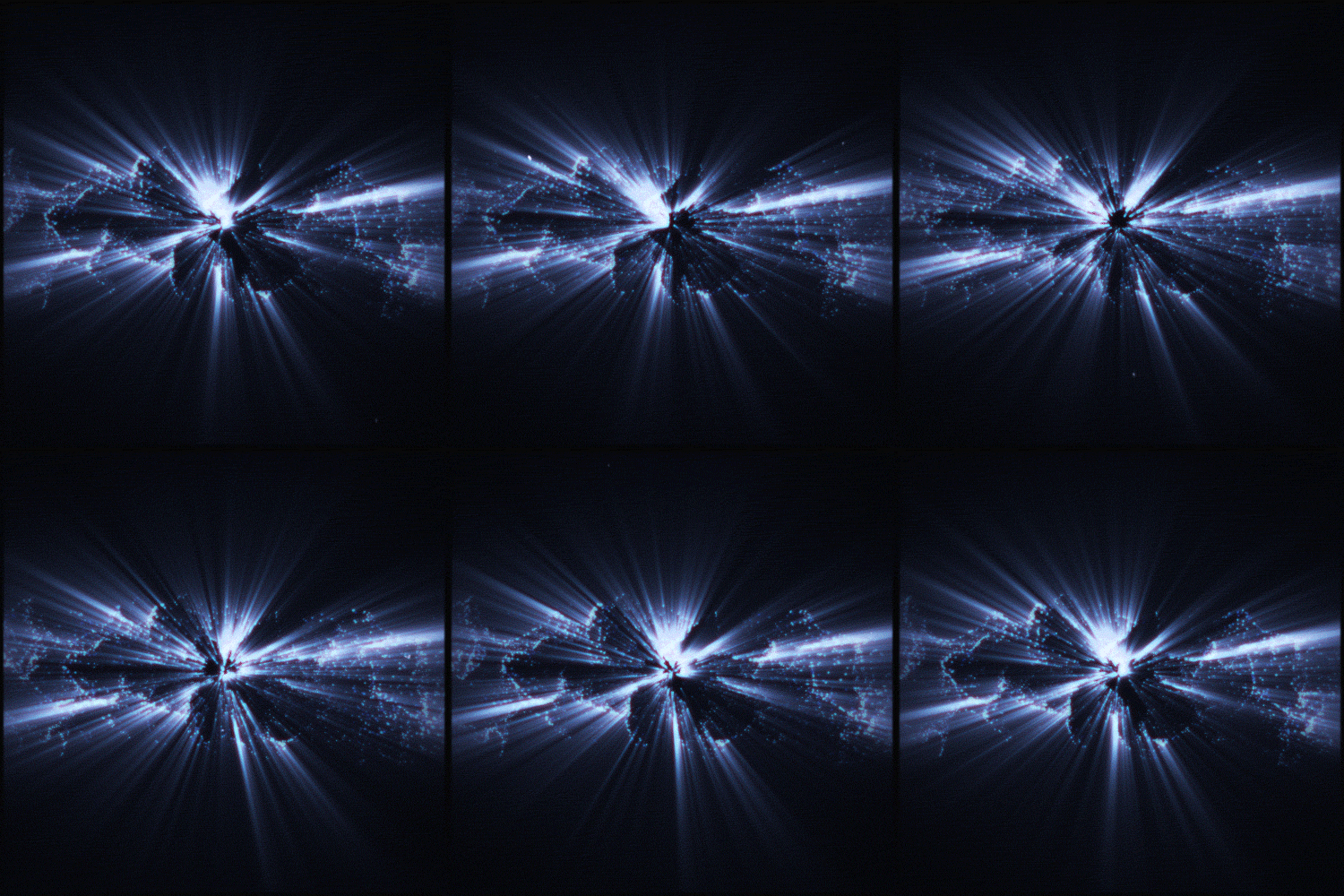
The first museum in the Netherlands dedicated to new media art. Discover large scale, multi-sensory exhibitions which challenge assumptions and open minds.Shifting Proximities will explore human experience and interaction in the face of social and technological change.The eight immersive, multi-sensory installations in our inaugural exhibition have been created in collaboration with artists, designers, technologists, scientists and musicians. The artworks fuse creative ideas with groundbreaking academic research and technological innovation; four of which have been commissioned by and will premiere at Nxt Museum Amsterdam.