8 apr 2020

Without Title


Found footage is a cinematic technique in which all or a substantial part of the work is presented as if it were film or video recordings recorded by characters in the story, and later "found" and presented to the audience. The events on screen are typically seen through the camera of one or more of the characters involved, often accompanied by their real-time, off-camera commentary. For added realism, the cinematography may be done by the actors themselves as they perform, and shaky camera work and naturalistic acting are routinely employed. The footage may be presented as if it were "raw" and complete or as if it had been edited into a narrative by those who "found" it. 


Dear Internet


Graphic design is the process of visual communication and problem-solving through the use of typography, photography, iconography and illustration. The field is considered a subset of visual communication and communication design, but sometimes the term "graphic design" is used synonymously. Graphic designers create and combine symbols, images and text to form visual representations of ideas and messages. They use typography, visual arts, and page layout techniques to create visual compositions. Common applications of graphic design include corporate design (logos and branding), editorial design (magazines, newspapers and books), wayfinding or environmental design, advertising, web design, communication design, product packaging, and signage.


6 apr 2020

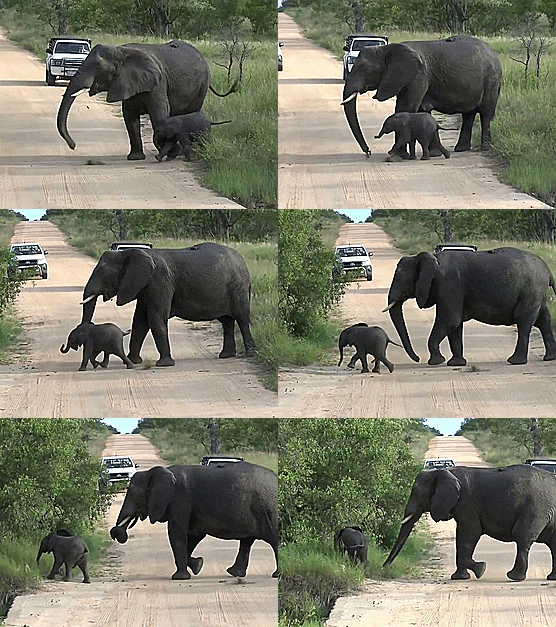
Namibia slideshow


Film is used for a range of goals, including education and propaganda. When the purpose is primarily educational, a film is called an "educational film". Examples are recordings of academic lectures and experiments, or a film based on a classic novel. Film may be propaganda, in whole or in part, such as the films made by Leni Riefenstahl in Nazi Germany, US war film trailers during World War II, or artistic films made under Stalin by Eisenstein. They may also be works of political protest, as in the films of Andrzej Wajda, or more subtly, the films of Andrei Tarkovsky. The same film may be considered educational by some, and propaganda by others as the categorization of a film can be subjective. 


3 apr 2020

Dutch colony


During the 1620s Jan Pieterszoon Coen in particular insisted that families and orphans be sent from Holland to populate the colonies. As a result, a number of single women were sent and an orphanage was established in Batavia to raise Dutch orphan girls to become East India brides. Around 1650, the number of mixed marriages, frequent in the early years of the Dutch East India Company (VOC), declined sharply. There was a large number of women from the Netherlands recorded as marrying in the years around 1650. At least half the brides of European men in Batavia came from Europe. Many of these women were widows, already previously married in the Indies, but almost half of them were single women from the Netherlands marrying for the first time. There were still considerable numbers of women sailing eastwards to the Indies at this time. The ships' passenger lists from the 17th century also evidence this. Not until later in the 17th century did the numbers of passengers to Asia drop drastically.


2 apr 2020

Dutch Treasures

An art film is typically a serious, independent film, aimed at a niche market rather than a mass market audience. It is "intended to be a serious, artistic work, often experimental and not designed for mass appeal" "made primarily for aesthetic reasons rather than commercial profit", and contains "unconventional or highly symbolic content".


29 mrt 2020

Czar Peter in Amsterdam


A comedy film is a genre of film in which the main emphasis is on humor. These films are designed to make the audience laugh through amusement and most often work by exaggerating characteristics for humorous effect. Films in this style traditionally have a happy ending (black comedy being an exception). One of the oldest genres in film – and derived from the classical comedy in theatre –, some of the very first silent movies were comedies, as slapstick comedy often relies on visual depictions, without requiring sound. When sound films became more prevalent during the 1920s, comedy films took another swing, as laughter could result from burlesque situations but also dialogue.

28 mrt 2020

Hermitage (long take)


In filmmaking, a long take (also called continuous take or continuous shot) is a shot lasting much longer than the conventional editing pace either of the film itself or of films in general. Significant camera movement and elaborate blocking are often elements in long takes, but not necessarily so. The term "long take" should not be confused with the term "long shot", which refers to the distance between the camera and its subject and not to the temporal length of the shot itself. The length of a long take was originally limited to how much film a motion picture camera could hold, but the advent of digital video has considerably lengthened the maximum potential length of a take. 


26 mrt 2020

Leipzig today


A propaganda film is a film that involves some form of propaganda. Propaganda films may be packaged in numerous ways, but are most often documentary-style productions or fictional screenplays, that are produced to convince the viewer of a specific political point or influence the opinions or behavior of the viewer, often by providing subjective content that may be deliberately misleading.


25 mrt 2020

Dutch Windmills


Dubbing, mixing, or re-recording is a post-production process used in filmmaking and video production in which additional or supplementary recordings are "mixed" with original production sound to create the finished soundtrack.
Outside the film industry, the term "dubbing" commonly refers to the replacement of the actor's voices with those of different performers speaking another language, which is called "revoicing" in the film industry.


21 mrt 2020

Film formats


A film format is a technical definition of a set of standard characteristics regarding image capture on photographic film, for either stills or filmmaking. It can also apply to projected film, either slides or movies. The primary characteristic of a film format is its size and shape.

In the case of motion picture film, the format may also include audio parameters (though often not). Other characteristics usually include the film gauge, pulldown method, lens anamorphosis (or lack thereof), and film gate or projector aperture dimensions, all of which need to be defined for photography as well as projection, as they may differ.