Swedish filmmaking rose to international prominence when Svenska Biografteatern moved from Kristianstad to Lidingö in 1911. During the next decade the company's two star-directors, Victor Sjöström and Mauritz Stiller, produced many outstanding silent films, some of the best of them adaptations of stories by the Nobel-prizewinning novelist Selma Lagerlöf. Sjöström's most respected films often made poetic use of the Swedish landscape and developed moving studies of character and emotion. Stiller fostered the early popularity of Greta Garbo, particularly through the Gösta Berlings saga (1924). Many of the films made at the Biografteatern had a significant impact on German directors of the silent and early sound eras, largely because Germany remained cut off from French, British, and American influences through World War I
1 sep 2019
The story of Swedish film
Swedish filmmaking rose to international prominence when Svenska Biografteatern moved from Kristianstad to Lidingö in 1911. During the next decade the company's two star-directors, Victor Sjöström and Mauritz Stiller, produced many outstanding silent films, some of the best of them adaptations of stories by the Nobel-prizewinning novelist Selma Lagerlöf. Sjöström's most respected films often made poetic use of the Swedish landscape and developed moving studies of character and emotion. Stiller fostered the early popularity of Greta Garbo, particularly through the Gösta Berlings saga (1924). Many of the films made at the Biografteatern had a significant impact on German directors of the silent and early sound eras, largely because Germany remained cut off from French, British, and American influences through World War I
22 aug 2019
Luctor et Emergo
There are productions that are best done on tape and there are productions best done on film.
News and sports, special events like variety shows and concerts, news-based and contemporary documentaries, industrials and educational programs are best done on tape. Anything that needs immediate presentation is obviously best done on tape.
Film, however, is best for any storytelling or narrative production. Historical documentaries, I think, are best done on film. Commercials are best done on film. Anything that is ""fantasy-based"" is best done on film. Why do I say this? Marshall McLuhan, the great media visionary, defined the difference between the hot medium and the cool medium as the audience's use of the imagination as opposed to the direct visual implant.
21 aug 2019
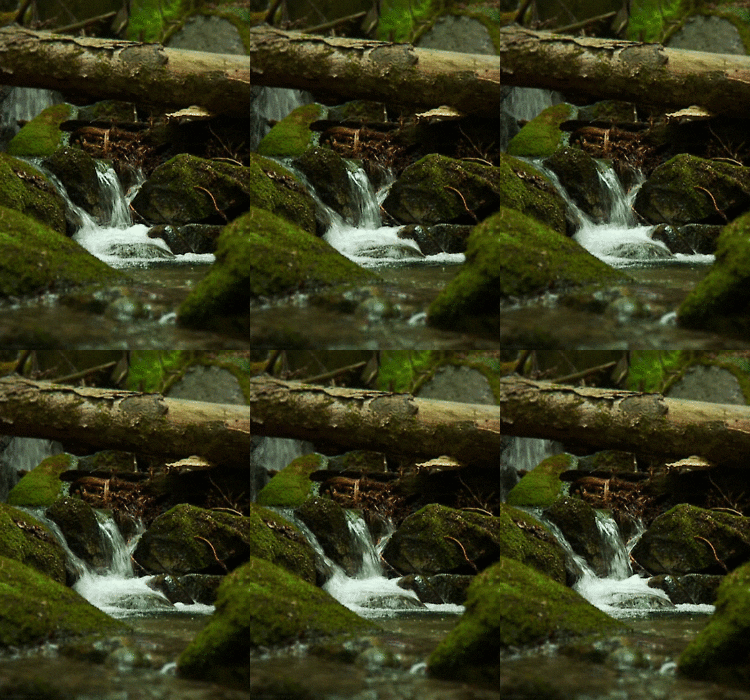
Tilberg Waterfall
Slow motion is ubiquitous in modern filmmaking. It is used by a diverse range of directors to achieve diverse effects. Some classic subjects of slow-motion include:
Athletic activities of all kinds, to demonstrate skill and style.
To recapture a key moment in an athletic game, typically shown as a replay.
Natural phenomena, such as a drop of water hitting a glass.
Slow motion can also be used for artistic effect, to create a romantic or suspenseful aura or to stress a moment in time
20 aug 2019
Flyer
Time-lapse photography is an interesting technique that records a scene or objects that has a slow state-of-change and turns it into a video that plays back in high speed. The easiest way to do it is to have your camera stationary on something that changes slowly (e.g. clouds, plants growing, etc) and start taking series of photo for hours or even days. Hours and hour’s worth of photos are compressed into a video with merely few minutes playtime, thus creating a time lapsing effect.
19 aug 2019
Holocaust or Holywood?
In the satirical Extras series by Ricky Gervais we get a (fictional) look behind the scenes of major film productions, with the extras in the spotlight. In this excerpt, Kate Winslet plays a nun in a Holocaust film that, once the camera is off, changes into her selfish self, who has only taken the role so that she can win an Oscar. According to interviewee Maxim Februari, it is a human trait to talk in a very committed way about terrible things, with the sole purpose of making yourself look better.
16 aug 2019
Pitlochry: salmon ladder
Pitlochry fish ladder, next to the Pitlochry Power Station on the River Tummel near Pitlochry, Perth and Kinross, Scotland – The ladder was completed in the early 1950s and consists of 34 separate pools, each 50 cm higher than the last and covering a distance of 310 m. Each pool has a 1 m opening below the water level to allow the fish to pass to the next pool. There are three larger pools which allow the fish to rest during their ascent, and one of these has an underwater viewing area with a glass wall for the public.
13 aug 2019
Jazz in North Brabant
Today more than ever, people know that films and videos are constructions made of screenwriting, acting, editing, sound design and are the result of hours of work and many people’s input. Because of this democratization of knowledge, the first layer of magic that was attached to film is gone. Nobody will ever scream watching a train entering its station because we know too much.
Chinese power
China is the home of the largest movie & drama production complex and film studios in the world, the Oriental Movie Metropolis and Hengdian World Studios, and in 2010 it had the third largest film industry by number of feature films produced annually. In 2012 the country became the second-largest market in the world by box office receipts. In 2016, the gross box office in China was CN¥45.71 billion (US$6.58 billion). The country has the largest number of screens in the world since 2016 and is expected to become the largest theatrical market by 2019. China has also become a major hub of business for Hollywood studios.
11 aug 2019
Swedish cinema
Swedish filmmaking rose to international prominence when Svenska Biografteatern moved from Kristianstad to Lidingö in 1911. During the next decade the company's two star-directors, Victor Sjöström and Mauritz Stiller, produced many outstanding silent films, some of the best of them adaptations of stories by the Nobel-prizewinning novelist Selma Lagerlöf. Sjöström's most respected films often made poetic use of the Swedish landscape and developed moving studies of character and emotion. Stiller fostered the early popularity of Greta Garbo, particularly through the Gösta Berlings saga (1924). Many of the films made at the Biografteatern had a significant impact on German directors of the silent and early sound eras, largely because Germany remained cut off from French, British, and American influences through World War I (1914–1918).
10 aug 2019
Heerengracht, Amsterdam
A one-shot or continuous shot feature film is a full-length movie filmed in one long take by a single camera, or manufactured to give the impression it was.