10 mei 2019

The Illusion of Movement

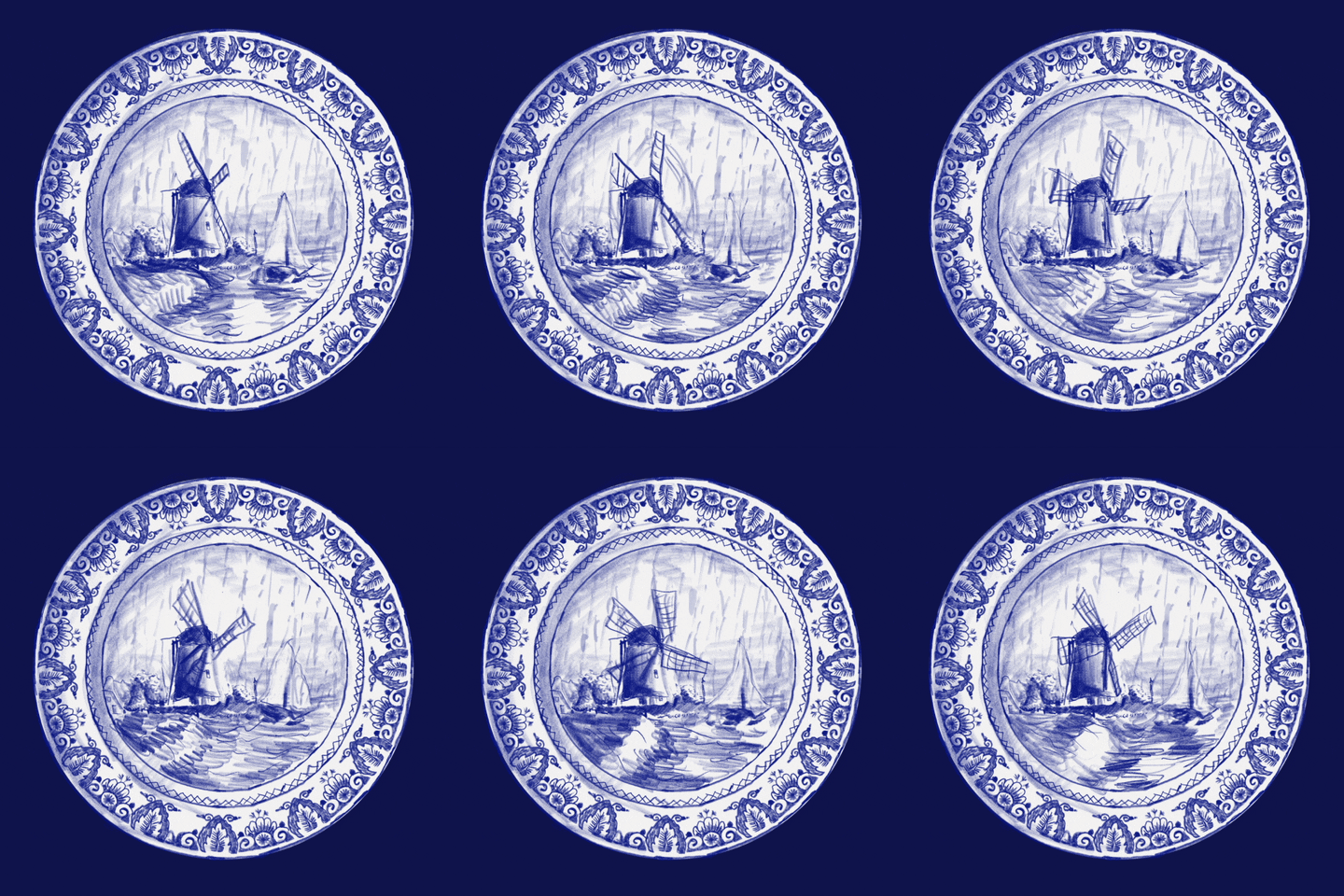
For the Eye Museum in Amsterdam, we were asked to make a teaser that displays the many things the Eye has in its collection. We chose to do the pre-cinema objects: Thaumatrope, Phenakistoscope and the Praxinoscope.

The phénakisticope (better known as phenakistiscope or the later misspelling phenakistoscope) was the first widespread animation device that created a fluid illusion of motion. The phenakistiscope is regarded as one of the first forms of moving media entertainment that paved the way for the future motion picture and film industry. Like a GIF animation, it can only show a short continuous loop.

9 mei 2019

Passage of Toledo


A tracking shot is any shot where the camera follows backward, forward or moves alongside the subject being recorded. In cinematography, the term refers to a shot in which the camera is mounted on a camera dolly that is then placed on rails – like a railroad track. A handheld steadycam or gimbal may also be used for smaller scale productions. The camera is then pushed along the track while the scene is being filmed or moved manually when using a handheld rig.

The technique is often used to follow a subject that would otherwise leave the frame (ergo, it is often called a following shot), such as an actor or vehicle in motion In this spirit, any conveyance, such as a motorized vehicle like a car, may also be used to create a tracking shot. A handheld or Steadicam mounted camera following a similar trajectory is called a tracking shot as well. While the core idea is that the camera moves parallel to its subject, a tracking shot may move in a semi-circular fashion, rotating around its subject while remaining equidistant.


8 mei 2019

Old fashioned Dutch Candy


Streaming media is multimedia that is constantly received by and presented to an end-user while being delivered by a provider. The verb "to stream" refers to the process of delivering or obtaining media in this manner;[clarification needed] the term refers to the delivery method of the medium, rather than the medium itself, and is an alternative to file downloading, a process in which the end-user obtains the entire file for the content before watching or listening to it.

7 mei 2019

Heimbach im Eifel


Montage theory, in its rudimentary form, asserts that a series of connected images allows for complex ideas to be extracted from a sequence and, when strung together, constitute the entirety of a film's ideological and intellectual power. 
In other words, the editing of shots rather than the content of the shot alone constitutes the force of a film. Many directors still believe that montage is what defines cinema against other specific media.


6 mei 2019

Beautiful Old Amsterdam


The earliest films were simply one static shot that showed an event or action with no editing or other cinematic techniques. Around the turn of the 20th century, films started stringing several scenes together to tell a story. The scenes were later broken up into multiple shots photographed from different distances and angles. Other techniques such as camera movement were developed as effective ways to tell a story with film. Until sound film became commercially practical in the late 1920s, motion pictures were a purely visual art, but these innovative silent films had gained a hold on the public imagination. Rather than leave audiences with only the noise of the projector as an accompaniment, theater owners hired a pianist or organist or, in large urban theaters, a full orchestra to play music that fit the mood of the film at any given moment. By the early 1920s, most films came with a prepared list of sheet music to be used for this purpose, and complete film scores were composed for major productions.


Eye Filmmuseum: Jean Desmet

Jean Desmet was one of the largest film entrepreneurs in the Netherlands and he documented and saved almost everything that had to do with his company: not only accounting and films, but also posters, advertising printed matter and cat's bubbles.; In this way an extraordinary archive was created. This received worldwide recognition in 2011 when UNESCO included it in its Memory of the World Register. With its collection, Eye manages more than 40,000 films from all genres: a fine sample of film history, from classics and blockbusters to cult films.
The Eye collection took shape in 1946 when the first predecessor of Eye was established: the Dutch Historical Film Archive. In 1952 the Nederlands Filmmuseum was born from the Dutch Historical Archive; since 2010 we are Eye.

Manipulation of images


On its most fundamental level, film editing is the art, technique and practice of assembling shots into a coherent sequence. The job of an editor is not simply to mechanically put pieces of a film together, cut off film slates or edit dialogue scenes. A film editor must creatively work with the layers of images, story, dialogue, music, pacing, as well as the actors' performances to effectively "re-imagine" and even rewrite the film to craft a cohesive whole. Editors usually play a dynamic role in the making of a film.

2 mei 2019

10 KM New Netherlands


The Netherlands. The first island was inaugurated on 24 September 2016.

Work on the first phase, which is mainly focused on the construction of the first island, started in April 2016.

The main aims of the project are to create breeding grounds, islands, and coast line as well as to improve the water ecology of the Markermeer. The project creates a wetland comparable with the Wadden Sea—hence the name of the project—yet without tides. This is because the Markermeer is not connected to the sea and is in a fresh water environment. The new nature reserve will be accessible to tourists.

On 11 May 2016, the first new land was created, which Natuurmonumenten called a "milestone". In March 2017, it was announced that four other islands should be completed before 2020.


Roel Reine


Roel Reine was born in The Netherlands, and with his first theatrical feature 'The Delivery' he won The Golden Calf for Best Director (the Dutch equivalent to an Academy Award). In 2005 Roel Reine has moved to Los Angeles and has directed now an impressive slate of 16 feature films for studios like Universal, 20th Century Fox, Sony and Lionsgate, as well with independent international producers. Roel is also the Director of Photography (Cinematographer) on all his movies and operates A-Camera.

Roel Reine is known by fans, critics and Hollywood studios as one of the best modern action Directors around today. Some of his last movies where: 'Seal Team Eight' (with Tom Sizemore), 'Dead in Tombstone' (with Mickey Rourke), 'Scorpion King: Battle for Redemption' (with Ron Perlman and Billy Zane) and two very popular 'Death Race - prequels' (with Sean Bean and Ving Rhames).

In 2014 Roel Reine is finishing a sequel to the movie 'Man with the Iron Fists', with rapper RZA and produced by Marc Abraham while prepping a Dutch language historical epic movie called 'The Admiral'. This last movie is the second most expensive movie ever produced in The Netherlands and tells the story of a 17th Century Admiral of the Ocean, Michiel De Ruyter, who protects the Dutch population from a civil war between two political factions while defeating English armada's in massive sea-battles.


1 mei 2019

Le Puy festivities


Mise-en-scène is an expression used to describe the design aspect of a theatre or film production, which essentially means "visual theme" or "telling a story"—both in visually artful ways through storyboarding, cinematography and stage design, and in poetically artful ways through direction. It is also commonly used to refer to single scenes within the film to represent the film. Mise-en-scène has been called film criticism's "grand undefined term".