6 aug 2016

Breaking the rules


The New Wave (French: La Nouvelle Vague) is a blanket term coined by critics for a group of French filmmakers of the late 1950s and 1960s.

Although never a formally organized movement, the New Wave filmmakers were linked by: their self-conscious rejection of the literary period pieces being made in France and written by novelists; their spirit of youthful iconoclasm; the desire to shoot more current social issues on location; and their intention of experimenting with the film form. "New Wave" is an example of European art cinema. Many also engaged in their work with the social and political upheavals of the era, making their radical experiments with editing, visual style and narrative part of a general break with the conservative paradigm.

Using portable equipment and requiring little or no set up time, the New Wave way of filmmaking presented a documentary style. The films exhibited direct sounds on film stock that required less light. Filming techniques included fragmented, discontinuous editing, and long takes. The combination of objective realism, subjective realism, and authorial commentary created a narrative ambiguity in the sense that questions that arise in a film are not answered in the end.
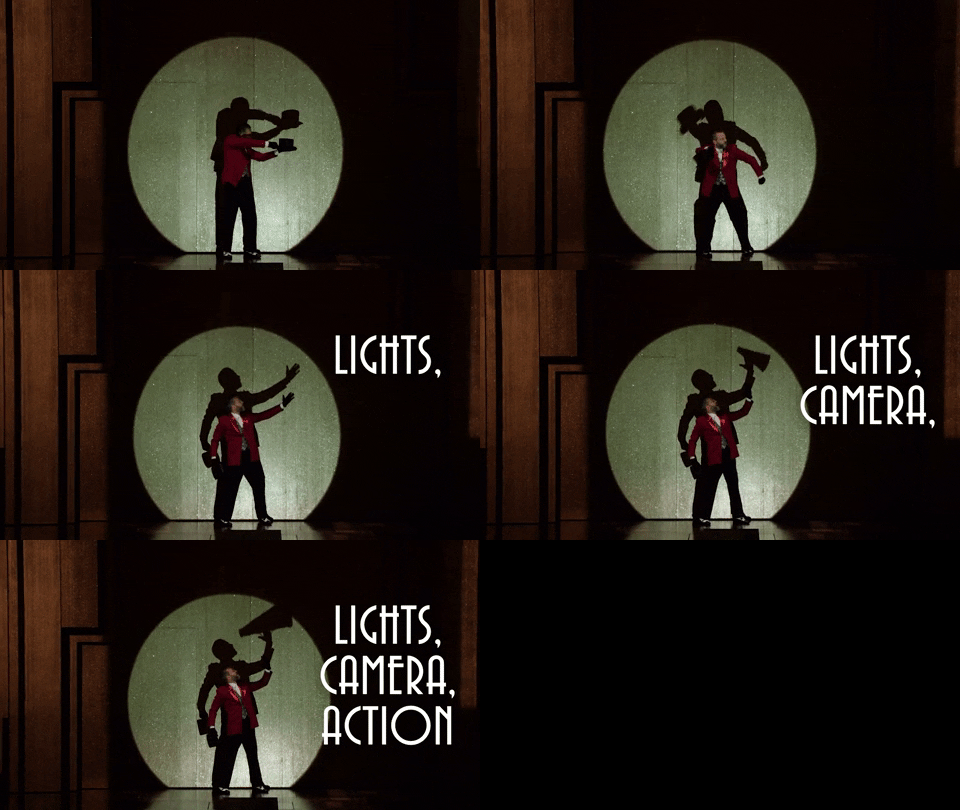


5 aug 2016

Hitman Bodyguard


The world's top bodyguard gets a new client, a hit man who must testify at the International Court of Justice. They must put their differences aside and work together to make it to the trial on time.
Director: Patrick Hughes
Writer: Tom O'Connor (screenplay)
Stars: Ryan Reynolds, Samuel L. Jackson, Salma Hayek 


100 years film-history


A supercut is a compilation of short video clips of the same type of action, a "fast-paced montage of short video clips that obsessively isolates a single element from its source, usually a word, phrase, or cliche from film and TV." The purpose is usually to create a comic effect.


Brabantse Sahara : Moving sand

A national park is a park in use for conservation purposes. Often it is a reserve of natural, semi-natural, or developed land that a sovereign state declares or owns. Although individual nations designate their own national parks differently, there is a common idea: the conservation of 'wild nature' for posterity and as a symbol of national pride. An international organization, the International Union for Conservation of Nature (IUCN), and its World Commission on Protected Areas, has defined "National Park" as its Category II type of protected areas.

National parks are almost always open to visitors. Most national parks provide outdoor recreation and camping opportunitie as well as classes designed to educate the public on the importance of conservation and the natural wonders of the land in which the national park is located.


Brazil:music


A music video is a short film integrating a song and imagery, produced for promotional or artistic purposes.Modern music videos are primarily made and used as a marketing device intended to promote the sale of music recordings. There are also cases where songs are used in tie in marketing campaigns that allow them to become more than just a song. Tie ins and merchandising could be used in toys or marketing campaigns for food and other products. Although the origins of music videos date back to musical short films that first appeared in the 1920s, they came into prominence in the 1980s when MTV based their format around the medium. Prior to the 1980s, these works were described by various terms including "illustrated song", "filmed insert", "promotional (promo) film", "promotional clip", "promotional video", "song video", "song clip" or "film clip".

4 aug 2016

Hitchcock explains about CUTTING

On its most fundamental level, film editing is the art, technique, and practice of assembling shots into a coherent sequence. The job of an editor is not simply to mechanically put pieces of a film together, cut off film slates, or edit dialogue scenes. A film editor must creatively work with the layers of images, story, dialogue, music, pacing, as well as the actors' performances to effectively "re-imagine" and even rewrite the film to craft a cohesive whole. Editors usually play a dynamic role in the making of a film. Sometimes, auteurist film directors edit their own films,


3 aug 2016

Berlin in July 1945 ( color footage)

Despite the advent of a regular television service in the Federal Republic in 1952, cinema attendances continued to grow through much of the 1950s, reaching a peak of 817.5 million visits in 1956. The majority of the films of this period set out to do no more than entertain the audience and had few pretensions to artistry or active engagement with social issues. The defining genre of the period was arguably the Heimatfilm ("homeland film"), in which morally simplistic tales of love and family were played out in a rural setting, often in the mountains of Bavaria, Austria or Switzerland. In their day Heimatfilms were of little interest to more scholarly film critics, but in recent years they have been the subject of study in relation to what they say about the culture of West Germany in the years of the Wirtschaftswunder. Other film genres typical of this period were adaptations of operettas, hospital melodramas, comedies and musicals. Many films were remakes of earlier Ufa productions.


Traveling en Drome


A LANDSCAPE : THE VERCORS

The Regional Natural Park of the Vercors could fill a book on its own. Most hikers know this 1 000 to 2 300 metre massif, (3 280 - 7 546 feet), such is its reputation as a citadel.

vercors2A vast plateau with difficult access roads, each attracting large numbers of tourists: the Grands Goulets, Combe Laval, the Col du Rousset pass… Sheep farming and forestry form the two essential economic activities.


Mills and more


The Dutch angle, also known as Dutch tilt, canted angle, oblique angle or German angle, is a type of camera shot where the camera is set at an angle on its roll axis so that the shot is composed with vertical lines at an angle to the side of the frame, or so that the horizon line of the shot is not parallel with the bottom of the camera frame. This produces a viewpoint akin to tilting one's head to the side.

In cinematography, the Dutch angle is one of many cinematic techniques often used to portray psychological uneasiness or tension in the subject being filmed.


2 aug 2016

Aix en Provence


Aix-en-Provence is situated in a plain overlooking the Arc, about a mile from the right bank of the river. The city slopes gently from north to south and the Montagne Sainte-Victoire can easily be seen to the east. Aix's position in the south of France gives it a warm climate, though more extreme than Marseille due to the inland location. It has an average January temperature of 5 °C (41 °F) and a July average of 23 °C (73 °F). It has an average of 300 days of sunshine and only 91 days of rain. While it is partially protected from the Mistral, Aix still occasionally experiences the cooler and gusty conditions it brings.

Unlike most of France which has an oceanic climate, Aix-en-Provence has a Mediterranean climate.