A film studio (also known as movie studio or simply studio) is a major entertainment company or motion picture company that has its own privately owned studio facility or facilities that are used to make films, which is handled by the production company. The majority of firms in the entertainment industry have never owned their own studios, but have rented space from other companies.
1 dec 2007
Entrada Welcome in Spain
A film studio (also known as movie studio or simply studio) is a major entertainment company or motion picture company that has its own privately owned studio facility or facilities that are used to make films, which is handled by the production company. The majority of firms in the entertainment industry have never owned their own studios, but have rented space from other companies.
Siena the square
World cinema is a term used primarily in English language speaking countries to refer to the films and film industries of non-English speaking countries. It is therefore often used interchangeably with the term foreign film. However, both world cinema and foreign film could be taken to refer to the films of all countries other than one's own, regardless of native language.
30 nov 2007
Town and Turia
After a catastrophic flood in 1957 which devastated the city of Valencia, the river was divided in two at the western city limits (Plan Sur de Valencia). The water has been diverted southwards along a new course that skirts the city, before meeting the Mediterranean. The old course of the river continues, dry, through the city centre, almost to the sea.
The old riverbed is now a verdant sunken park that allows cyclists and pedestrians to traverse much of the city without the use of roads. The park, called the 'Garden of the Turia' (Jardí del Túria/Jardín del Turia) boasts numerous ponds, paths, fountains, flowers, football pitches, cafés, artworks, climbing walls, an athletics track, a zen garden and more. The many bridges overhead carry traffic across the
park.
The Best of Freiburg
One of the famous old German university towns, and archiepiscopal seat, Freiburg was incorporated in the early twelfth century and developed into a major commercial, intellectual, and ecclesiastical center of the upper Rhine region. The city is known for its medieval university and minster, as well as for its high standard of living and advanced environmental practices. The city is situated in the heart of a major wine-growing region and serves as the primary tourist entry point to the scenic beauty of the Black Forest. According to meteorological statistics, the city is the sunniest and warmest in Germany and holds the German temperature record of 40.2 °C (104.4 °F).
Around Trasimeno
The Cinema of Italy comprises the films made within Italy or by Italian directors. Since the development of the Italian film industry in the early 1900s, Italian filmmakers and performers have, at times, experienced both domestic and international success, and have influenced film movements throughout the world. As of 2014, Italian films have won 14 Academy Awards for Best Foreign Language Film, the most of any country, as well as 12 Palmes d'Or, the second-most of any country.
29 nov 2007
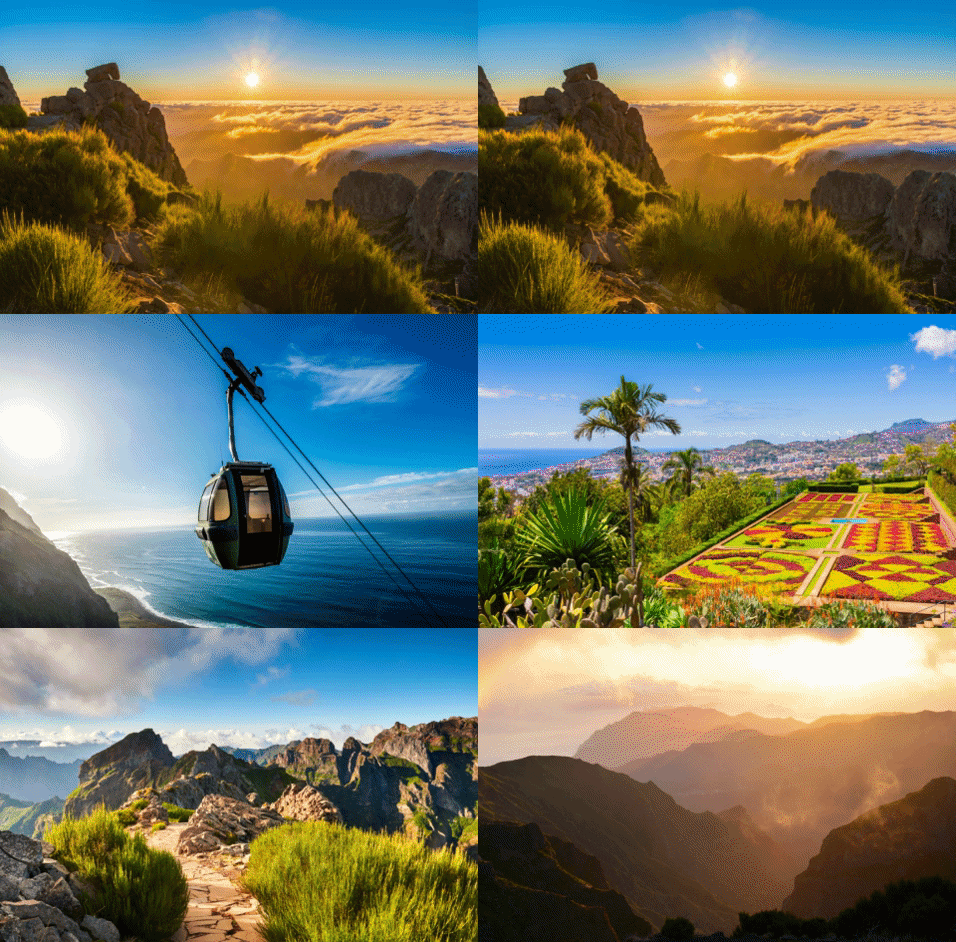
Famous Sunny Madeira
Madeira was claimed by Portuguese sailors in the service of Henry the Navigator in 1419, and settled after 1420. The archipelago is considered to be the first territorial discovery of the exploratory period of the Portuguese Age of Discovery.
Today, it is a popular year-round resort, being visited every year by about one million tourists, noted for its Madeira wine, flowers, landscapes and embroidery artisans, as well as for its annual New Year celebrations that feature the largest fireworks show in the world, as officially recognised by the Guinness World Records, in 2006. The main harbour in Funchal is the leading Portuguese port in cruise liner dockings,[ being an important stopover for commercial and trans-Atlantic passenger cruises between Europe, the Caribbean and North Africa.
Pikes Peak
Pikes Peak (originally Pike's Peak) is a mountain in the Front Range of the Rocky Mountains within Pike National Forest, 10 mi (16 km) west of Colorado Springs, Colorado, in El Paso County in the United States of America.
Originally called "El Capitán" by Spanish settlers, the mountain was renamed Pike's Peak after Zebulon Pike, Jr., an explorer who led an expedition to the southern Colorado area in 1806. The Arapaho name is heey-otoyoo’ ("long mountain")
At 14,115 feet (4,302 m), it is one of Colorado's 54 fourteeners, mountains that rise more than 14,000 feet (4,300 m) above mean sea level, and rises 8,400 feet (2,600 m) above the city of Colorado Springs. Pikes Peak is a designated National Historic Landmark.
28 nov 2007
Siena in Italy
Schrader used his new project, a 10-episode web series called Life on the Other Side inspired by Federico Fellini’s La Dolce Vita, to discuss a new era in the filmmaking business. "If Fellini were alive today, he’d make La Dolce Vita as a web series, because maybe that’s a better way to make it than a three hour movie,” he said.
“We’re entering into a new era when so much of the old rules are changing. We don’t know how long a film is no more. We used to think a film was somewhere between an hour and a half and two hours. But now it’s somewhere between 3 minutes and 70 hours. You know, Mad Men is a movie. And we’re seeing the rise of new concepts. The film studios of the future are going be called Amazon and Google — and they are already called Netflix. This is where filmmaking and film-going is headed,” he stated.
Altenburg Castle
Rule of thirds A good guideline for composing your shots is the rule of thirds. This means that you should imagine your frame (the image your camera takes) divided into thirds, with actions and objects placed at the intersections of the vertical and horizontal thirds. This is far more interesting to the eye. Don’t place people you are fi lming in the middle of the frame simply because they are important. It’s far better to have the horizon either two-thirds from the top of the frame or two-thirds from the bottom. And if you are fi lming someone standing in front of a wider scene it’s good to have him or her standing slightly to the left or to the right of the frame. This permits the person to speak into the empty part of the frame—it gives them “nose-room.”
27 nov 2007
Panorama of Florence
In photography, panning refers to the rotation in a horizontal plane of a still camera or video camera. Panning a camera results in a motion similar to that of someone shaking their head from side to side or of an aircraft performing a yaw rotation. Or to that of an opening door if the door stays facing one way.
Filmmaking and professional video cameras pan by turning horizontally on a vertical axis, but the effect may be enhanced by adding other techniques, such as rails to move the whole camera platform. Slow panning is also combined with zooming in or out on a single subject, leaving the subject in the same portion of the frame, to emphasize or de-emphasize the subject respectively.
In still photography, the panning technique is used to suggest fast motion, and bring out the subject from other elements in the frame. In photographic pictures it is usually noted by a foreground subject in action appearing still (i.e. a runner frozen in mid-stride) while the background is streaked and/or skewed in the apparently opposite direction of the subject's travel, similar to speed lines, and is often used in sports photography, primarily of racing.