17 okt 2011

Art in Lyon


Art films are aimed at small niche market audiences, which means they can rarely get the financial backing which will permit large production budgets, expensive special effects, costly celebrity actors, or huge advertising campaigns, as are used in widely-released mainstream blockbuster films. Art film directors make up for these

constraints by creating a different type of film, which typically uses lesser-known film actors (or even amateur actors) and modest sets to make films which focus much more on developing ideas or exploring new narrative techniques or filmmaking conventions.

14 okt 2011

Fly Away in Bird Park


 Filminfo:


Dubbing is the post-production process of recording and replacing voices on a motion picture or television soundtrack subsequent to the original shooting.

The term most commonly refers to the substitution of the voices of the actors shown on the screen by those of different performers, who may be speaking a different language.  "Dubbing" also describes the process of an actor re-recording lines spoken during filming in order to improve audio quality or reflect dialog changes

10 okt 2011

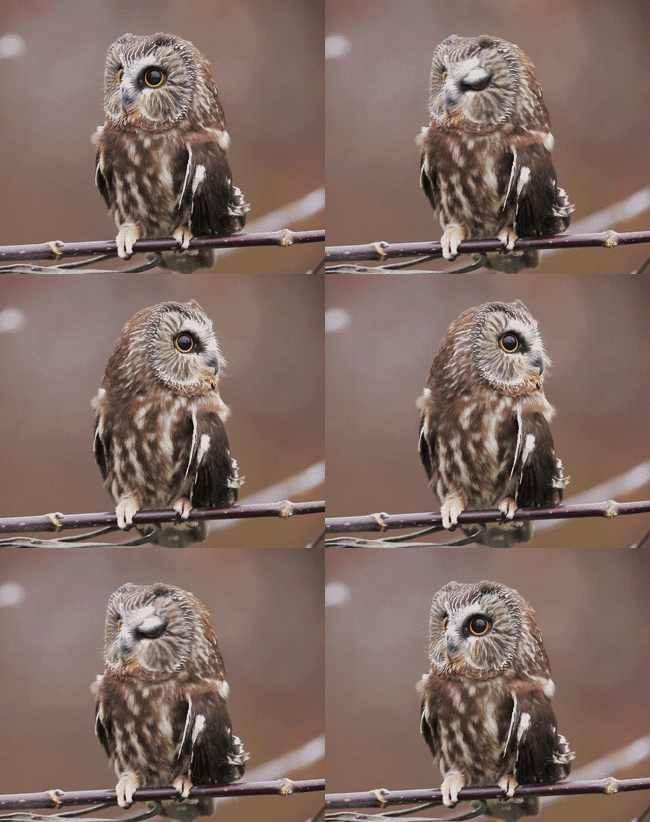
Say cheese


In cinematography, a take refers to each filmed "version" of a particular shot or "setup". Takes of each shot are generally numbered starting with "take one" and the number of each successive take is increased (with the director calling for "take two" or "take eighteen") until the filming of the shot is completed.


A one-take occurs when the entire scene is shot satisfactorily the first time, whether by necessity (as with certain expensive special effects) or by happy accident.


Film takes are often designated with the aid of a clapperboard. It is also referred to as the slate. The number of each take is written or attached to the clapboard, which is filmed briefly prior to or at the beginning of the actual take. Only takes which are vetted by the continuity person and/or script supervisor are printed and are sent to the film editor.

8 okt 2011

Schiphol Airport 1939


Aerial photography is the taking of photographs of the ground from an elevated/direct-down position. Usually the camera is not supported by a ground-based structure. Platforms for aerial photography include fixed-wing aircraft, helicopters, unmanned aerial vehicles (UAVs or "drones"), balloons, blimps and dirigibles, rockets, pigeons, kites, parachutes, stand-alone telescoping and vehicle-mounted poles. Mounted cameras may be triggered remotely or automatically; hand-held photographs may be taken by a photographer.

schiphol was a polder under sea level


the old city of Lyon


In the past, most independent filmmakers have relied on film festivals to get their films noticed and sold for distribution. However, the Internet has allowed for relatively inexpensive distribution of independent films. As a result several companies have emerged to assist filmmakers in getting independent movies seen and sold via mainstream internet marketplaces, oftentimes adjacent to popular Hollywood titles. With internet movie distribution, independent filmmakers who fail to garner a traditional distribution deal now have the ability to reach global audiences.


7 okt 2011

(farm)House in Holland


A narrator is, within any story of a movie, the person who tells the story to the audience. When the narrator is also a character within the story, he or she is sometimes known as the viewpoint character. The narrator is one of three entities responsible for story-telling of any kind. The others are the author and the audience.

The author and the audience both inhabit the real world. It is the author's function to create the universe, people, and events within the story. It is the audience's function to understand and interpret the story. The narrator only exists within the world of the story and present it in a way the audience can comprehend.


6 okt 2011

Perouges in dept: Ain


The 20th century is not the first to create images of life during medieval times. The Middle Ages ended over five centuries ago and each century has imagined, portrayed and depicted the Middle Ages through painting, architecture, poetry, music and novel. In the 20th century, film has defined Medieval history perhaps more so than any other medium. While the conclusions of academic research and findings of archeology have advanced knowledge of the Middle Ages, nothing has had more widespread influence on more people than the images created by film.

5 okt 2011

Typical French (Champagne)


A film genre is a motion picture category based on similarities in either the narrative elements or the emotional response to the film (namely, serious, comic, etc.). Most theories of film genre are borrowed from literary genre criticism. The basic genres include fiction and documentary, from which subgenres have emerged, such as docufiction and docudrama. Other subgenres include the courtroom and trial-focused drama known as the legal drama. Types of fiction which may seem unrelated can also be combined to form hybrid subgenres, such as the melding of horror and comedy in the Evil Dead films. Other popular combinations are the romantic comedy and the action comedy film.


4 okt 2011

Medieval Perouges, the church


Documentary films constitute a broad category of nonfictional motion pictures intended to document some aspect of reality, primarily for the purposes of instruction or maintaining a historical record. A "documentary film" was originally a movie shot on film stock—the only medium available—but now includes video and digital productions that can be either direct-to-video or made for a television program. "Documentary" has been described as a "filmmaking practice, a cinematic tradition, and mode of audience reception" that is continually evolving and is without clear boundaries.


2 okt 2011

Tramway


In motion picture terminology, a tracking shot (also known as a dolly shot or trucking shot) is a segment in which the camera is mounted on a camera dolly, a wheeled platform that is pushed on rails while the picture is being taken. One may dolly in on a stationary subject for emphasis, or dolly out, or dolly beside a moving subject (an action known as "dolly with").