14 jan 2024

Southern Thailand


Cross-cutting is an editing technique most often used in films to establish action occurring at the same time, and often in the same place. In a cross-cut, the camera will cut away from one action to another action, which can suggest the simultaneity of these two actions but this is not always the case. Cross-cutting can also be used for characters in a film with the same goals but different ways of achieving them.


13 jan 2024

Common Amsterdam


Since the late 1970s, cult films have become increasingly popular. Films that once would have been limited to obscure cult followings are now capable of breaking into the mainstream, and showings of cult films have proved to be a profitable business venture. Overbroad usage of the term has resulted in controversy, as purists state it has become a meaningless descriptor applied to any film that is the slightest bit weird or unconventional; others accuse Hollywood studios of trying to artificially create cult films or use the term as a marketing tactic. Films are frequently stated to be an "instant cult classic" now, occasionally before they are released. Some films have acquired massive, quick cult followings, owing to advertisements and posts made by fans spreading virally through social media. Easy access to cult films via video on demand and peer-to-peer file sharing has led some critics to pronounce the death of cult films.


12 jan 2024

Ubekistan

With the growing diversification of studios into such fields as video games, television stations, broadcast syndication, television, theme parks, home video and publishing, they have become multi-national corporations. International markets account for a growing proportion of Hollywood movie revenue, with approximately 70% of total movie revenue coming from international ticket sales; and the Chinese domestic box-office revenue is projected to outpace those of US in 2020.[8] The growth of film studios and filmmaking outside of Hollywood and the US has produced popular international film studio locations such as Hollywood North (Vancouver and Toronto in Canada), Bollywood (Mumbai, India), and Nollywood (Lagos, Nigeria)

11 jan 2024

Buster Keaton stunts


A stunt performer, often called a stuntman or stuntwoman and occasionally stuntperson or stunt-person, is a trained professional who performs daring acts, often as a career. Stunt performers usually appear in films or on television, as opposed to a daredevil, who performs for a live audience. When they take the place of another actor, they are known as stunt doubles. A stunt performer performs stunts intended for use in a film or dramatized television. Stunts seen in films and television include car crashes, falls from great height, drags (for example, behind a horse), and explosions. 


10 jan 2024

Prison gate


Thriller film, also known as suspense film or suspense thriller, is a broad film genre that evokes excitement and suspense in the audience. The suspense element found in most films' plots is particularly exploited by the filmmaker in this genre. Tension is created by delaying what the audience sees as inevitable, and is built through situations that are menacing or where escape seems impossible. The cover-up of important information from the viewer, and fight and chase scenes are common methods.


9 jan 2024

Colourful Paris


In cinematography, a tracking shot is any shot where the camera follows backward, forward or moves alongside the subject being recorded. Often the camera is mounted on a camera dolly which rides on rails similar to a railroad track; in this case, the shot is referred to as a dolly shot. A handheld steadycam or gimbal may also be used for smaller scale productions. The camera is then pushed along the track while the scene is being filmed, or moved manually when using a handheld rig. The effect can be used to create a sense of movement, to follow a character or object, or a sense of immersion to draw the viewer into the action. 


7 jan 2024

Daniel Blake


 "I am not a client, a customer, nor a service user. I am not a shirker, a scrounger, a beggar, nor a thief. I'm not a National Insurance Number or blip on a screen. I paid my dues, never a penny short, and proud to do so. I don't tug the forelock, but look my neighbour in the eye and help him if I can. I don't accept or seek charity. My name is Daniel Blake. I am a man, not a dog. As such, I demand my rights. I demand you treat me with respect. I, Daniel Blake, am a citizen, nothing more and nothing less."


6 jan 2024

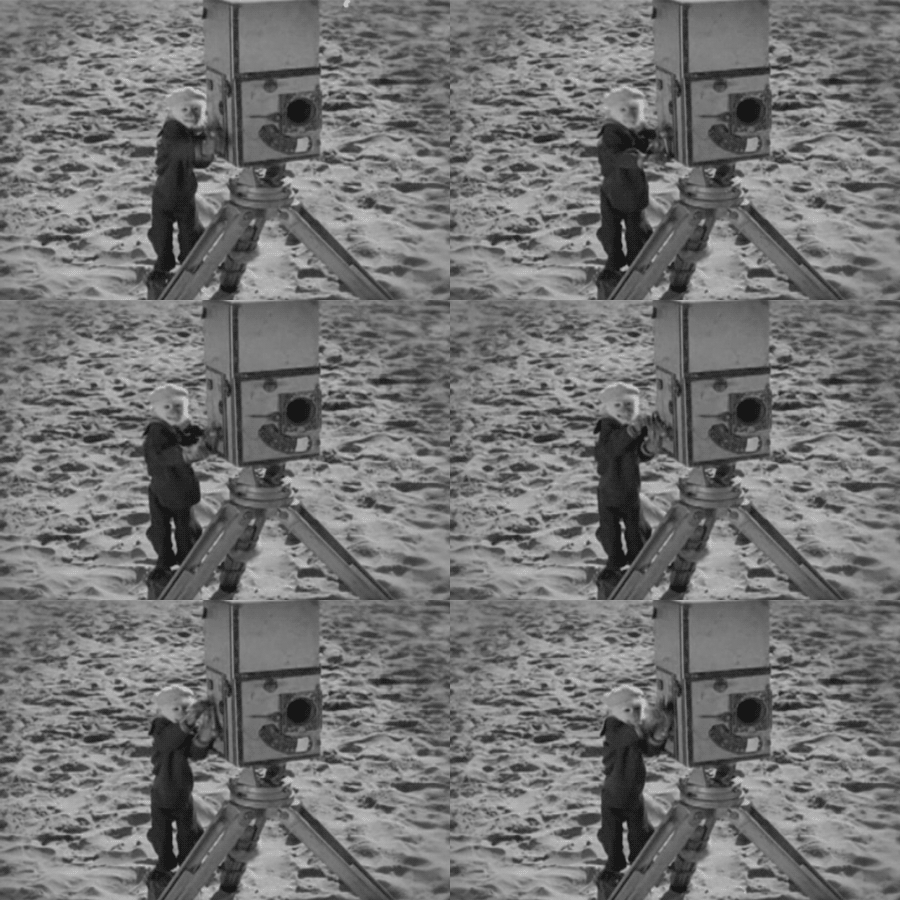
The Cameraman


A camera operator in a video production may be known by titles like television camera operator, video camera operator, or videographer, depending on the context and technology involved, usually operating a professional video camera. As of 2016, there were approximately 59,300 television, video, and motion picture camera operators employed in the United States.

Important camera operator skills include choreographing and framing shots, knowledge of and the ability to select appropriate camera lenses, and other equipment (dollies, camera cranes, etc.) to portray dramatic scenes. The principles of dramatic storytelling and film editing fundamentals are also important skills. The camera operator is required to communicate clearly and concisely on sets where time and film budget constraints are ever present


Middlesbrough people


Docudrama (or documentary drama) is a genre of television and film, which features dramatized re-enactments of actual events. It is described as a hybrid of documentary and drama and "a fact-based representation of real event". Docudramas typically strive to adhere to known historical facts, while allowing some degree of dramatic license in peripheral details, such as when there are gaps in the historical record. Dialogue may, or may not, include the actual words of real-life people, as recorded in historical documents. Docudrama producers sometimes choose to film their reconstructed events in the actual locations in which the historical events occurred. 


5 jan 2024

Dutch Pig Export


In the performing arts industry such as theatre, film, or television, casting, or a casting call, is a pre-production process for selecting a certain type of actor, dancer, singer, or extra for a particular role or part in a script, screenplay, or teleplay. This process may be used for a motion picture, television program, documentary film, music video, play, or advertisement, intended for an audience. 


4 jan 2024

Big Mouth


 In motion picture and television production, a sound effect is a sound recorded and presented to make a specific storytelling or creative point without the use of dialogue or music. Traditionally, in the twentieth century, they were created with Foley. The term often refers to a process applied to a recording, without necessarily referring to the recording itself. In professional motion picture and television production, dialogue, music, and sound effects recordings are treated as separate elements. Dialogue and music recordings are never referred to as sound effects, even though the processes applied to such as reverberation or flanging effects, often are called "sound effects". 


2 jan 2024

Golden Touch


A fairy tale (alternative names include fairytale, fairy story, magic tale, or wonder tale) is a short story that belongs to the folklore genre. Such stories typically feature magic, enchantments, and mythical or fanciful beings. In most cultures, there is no clear line separating myth from folk or fairy tale; all these together form the literature of preliterate societies. Fairy tales may be distinguished from other folk narratives such as legends (which generally involve belief in the veracity of the events described) and explicit moral tales.


1 jan 2024

Happy New Year


In live-action film, a storyboard artist is hired at the beginning of a project. When a storyboard artist is hired by a motion picture company, the artist must break down the scenes of the script into shots that can be filmed. This is done under the supervision of the film's director in order to ensure the director's vision from the start of the project. As the production proceeds, the storyboards are presented to the cinematographer who is then responsible for bringing that vision to the screen. 


25 dec 2023

Malaysia tour


Consumer camcorders have switched from being tape-based to tapeless machines that record video as computer files. Small hard disks and writable optical discs have been used, with solid-state memory such as SD cards being the current market leader. There are two primary advantages: First, copying a tape recording onto a computer or other video machine occurs in real time (e.g. a ten-minute video would take ten minutes to copy); since tapeless camcorders record video as computer-ready data files, the files can simply be copied onto a computer. Second, tapeless camcorders, and those using solid-state memory in particular, are far simpler mechanically and so are more reliable.

23 dec 2023

Taste the Zaan Region


Experimental filmmakers generally begin as amateurs, and some use experimental films as a springboard into commercial film-making or transition into academic positions. The aim of experimental filmmaking may be to render the personal vision of an artist, or to promote interest in new technology rather than to entertain or to generate revenue, as is the case with commercial films 


19 dec 2023

Millers education


What is a film still in cinema? A film still, also known as a movie still or production still, is a photograph taken during the production of a movie or a television program. It is a moment captured from the cinematic narrative, a frozen frame that presents a scene, a character, or a detail in its raw, unaltered state. These stills often become iconic images, immortalizing poignant and memorable moments from the film


18 dec 2023

Long take


In filmmaking, a long take (also called a continuous take, continuous shot, or oner) is shot with a duration much longer than the conventional editing pace either of the film itself or of films in general. Significant camera movement and elaborate blocking are often elements in long takes, but not necessarily so. The term "long take" should not be confused with the term "long shot", which refers to the distance between the camera and its subject and not to the temporal length of the shot itself. The length of a long take was originally limited to how much film the magazine of a motion picture camera could hold, but the advent of digital video has considerably lengthened the maximum potential length of a take.


17 dec 2023

Krommenie


Non-linear editing is a form of offline editing for audio, video, and image editing. In offline editing, the original content is not modified in the course of editing. In non-linear editing, edits are specified and modified by specialized software. A pointer-based playlist, effectively an edit decision list (EDL), for video and audio, or a directed acyclic graph for still images, is used to keep track of edits. Each time the edited audio, video, or image is rendered, played back, or accessed, it is reconstructed from the original source and the specified editing steps. Although this process is more computationally intensive than directly modifying the original content, changing the edits themselves can be almost instantaneous, and it prevents further generation loss as the audio, video, or image is edited. 


16 dec 2023

Alpine circle


Here are some tips from me that will help your video stand out:
Tip 1: High resolution videos, 4K would be better
Tip 2: Keep these clips short – under 60 seconds
Tip 3: Change the sound – videos without sound get more views
Tip 4: Clean your lens!
And leaving the best tip for last…Tip 5: stabilize your images.


15 dec 2023

Zaandam


Telling a story In a dramatic motion picture, the story is told by many people. The cinematographer tells the story with the camera. The lighting person tells the story with lighting. The film composer tells the story with music. The actors tell the story with action and dialog. The editor tells the story with editing. The sound designer tells the story with sound.