19 okt 2017

Romans' Way


Vienne is a commune in southeastern France, located 32 kilometres (20 mi) south of Lyon, on the river Rhône. It is only the fourth largest city in the Isère department, of which it is a subprefecture, but was a major center of the Roman empire.

Before the arrival of the Roman armies, Vienne was the capital city of the Allobroges, a Gallic people. Transformed into a Roman colony in 47 BCE under Julius Caesar, Vienne became a major urban center, ideally located along the Rhône, then a major axis of communication. It was to Vienne in 7 CE that Augustus banished King Herod Archelaus, so the Herodian family may have had land there. The town later became a Roman provincial capital. Numerous remains of Roman constructions are still visible in modern Vienne

17 okt 2017

Raining Cats and Dogs


His Master's Voice (HMV) is a famous trademark in the recording industry and was the unofficial name of a major British record label. The phrase was coined in the 1890s as the title of a painting of a terrier mix dog named Nipper, listening to a wind-up disc gramophone. In the original painting, the dog was listening to a cylinder phonograph. In the 1970s, the statue of the dog and gramophone, His Master's Voice, were cloaked in bronze and was awarded by the record company (EMI) to artists or music producers or composers as a music award and often only after selling more than 100.000 sound carriers such as LPs.


14 okt 2017

Montpellier, the old city


Video production is the process of creating video by capturing moving images (videography), and creating combinations and reductions of parts of this video in live production and post-production (video editing). In most cases the captured video will be recorded on the most current electronic media such as SD cards. In the past footage was captured on video tape, hard disk, or solid state storage. Video tape capture is now obsolete and solid state storage is reserved for just that, storage. It is now distributed digitally in formats such as the Moving Picture Experts Group format (.mpeg, .mpg, .mp4), QuickTime (.mov), Audio Video Interleave (.avi), Windows Media Video[1] (.wmv), and DivX (.avi, .divx). It is the equivalent of filmmaking, but with images recorded digitally instead of on film stock.


13 okt 2017

Entree of the Ardeche (valley)


Shooting in the round refers to a style in cinematography in which the 180-degree rule is broken and the actors are filmed from all sides.

During TV show panel discussions, shooting in the round can help the guests feel like all the panelists are equal and create a feeling of greater intimacy.

The name of the style is originally brought from the theater, called theatre in the round.


11 okt 2017

La Petite Camargue


A natural history film or wildlife film is a documentary film about animals, plants, or other non-human living creatures, usually concentrating on film taken in their natural habitat but also often including footage of trained and captive animals. Sometimes they are about wild animals, plants, or ecosystems in relationship to human beings. Such programmes are most frequently made for television, particularly for public broadcasting channels, but some are also made for the cinema medium. The proliferation of this genre occurred almost simultaneously alongside the production of similar television series.


10 okt 2017

La Grande Motte


A step outline (more commonly called a beat sheet) is a detailed telling of a story with the intention of turning the story into a screenplay for a motion picture.

The step outline briefly details every scene of the screenplay's story, and often has indications for dialog and character interactions. The scenes are often numbered for convenience.

It can also be an extremely useful tool for a writer working on a spec script.


9 okt 2017

Finding Film Ideas


Backlight (Dutch: Tegenlicht) is a documentary television series by Dutch public broadcasting organisation VPRO. The first episode of Backlight was broadcast on 8 September 2002.

The series "aims to grasp the quintessence of prominent trends and developments" in the practice of critical journalism, and tries to improve understanding of the intricate inner workings of our modern society.


Wijnegem mall near Antwerp


The first camera using digital electronics to capture and store images was developed by Kodak engineer Steven Sasson in 1975. He used a charge-coupled device (CCD) provided by Fairchild Semiconductor, which provided only 0.01 megapixels to capture images. Sasson combined the CCD device with movie camera parts to create a digital camera that saved black and white images onto a cassette tape. The images were then read from the cassette and viewed on a TV monitor.  Later, cassette tapes were replaced by flash memory.


Fleur de sel


Each year, Aigues-Mortes produces 500,000 tons of salt, making it a worldwide benchmark.
In the Camargue, salt can be found widely in the soil, and the nature of the flat and clayey land, dotted with ponds, lends itself well to the extraction of sea salt. It is also a region where evaporation is the most intense and rainfall the weakest.

The salt production in Aigues-Mortes goes back to Antiquity. Peccius, a Roman engineer at the start of the Christian Era, was put in charge of organising salt production.
In 1856, the different salt marsh owners united to found the Salins du Midi (Saltworks of the South).


NRA - Sunday with Lubach


An anti-war movement (also antiwar) is a social movement, usually in opposition to a particular nation's decision to start or carry on an armed conflict, unconditional of a maybe-existing just cause. The term can also refer to pacifism, which is the opposition to all use of military force during conflicts. Many activists distinguish between anti-war movements and peace movements. Anti-war activists work through protest and other grassroots means to attempt to pressure a government (or governments) to put an end to a particular war or conflict.


8 okt 2017

Grand Causses


The Causses and the Cévennes, Mediterranean agro-pastoral Cultural Landscape located in the southern part of central France with over three millennia of agro-pastoral history.
The region is mountainous with numerous narrow valleys, making conditions poorly suited to host cities, but well-suited for pastoralism. Consequently, the landscape of Causses and Cévennes evolved over time to reflect all types of Mediterranean agro-pastoral systems. The Causses and the Cévennes retain numerous testimonies of this evolution of pastoralism over time. Mont Lozère is one of the last places where summer transhumance is still practiced in the traditional way.


6 okt 2017

Reunion de Aigues-Mortes


Time and technology have not only changed the techniques of filmmaking but have also made giving the “first take” a more comfortable affair. There are some huge changes in terms of filmmaking techniques (in the last couple of decades). Digital (technology) has changed a lot of things. Things are done a lot faster now… In a way, that’s good.

Stop worrying about the first take though, because it’s so easy to do one more now, earlier there was a lot more attention on getting it right on the first attempt itself.

3 okt 2017

Cirque de Navacelles


Good news: we're all for a visual treat. The BBC has announced nature series Planet Earth II, a follow-up to the original ratings winner, aired ten years ago
As gear has got smaller, lighter and more sophisticated, aerial filming no longer always has to involve expensive helicopters and static cranes. Production companies are increasingly using drones to nail those shots that require dramatic panoramas, adrenalin-filled action sequences, 360-degree views of subjects or literal birds’ eye views.


Above Ardeche


Observational documentaries attempt to simply and spontaneously observe lived life with a minimum of intervention. Filmmakers who worked in this subgenre often saw the poetic mode as too abstract and the expository mode as too didactic. The first observational docs date back to the 1960s; the technological developments which made them possible include mobile lighweight cameras and portable sound recording equipment for synchronized sound. Often, this mode of film eschewed voice-over commentary, post-synchronized dialogue and music, or re-enactments. The films aimed for immediacy, intimacy, and revelation of individual human character in ordinary life situations.


2 okt 2017

Future Food


A film essay (or "cinematic essay") consists of the evolution of a theme or an idea rather than a plot per se, or the film literally being a cinematic accompaniment to a narrator reading an essay. From another perspective, an essay film could be defined as a documentary film visual basis combined with a form of commentary that contains elements of self-portrait (rather than autobiography), where the signature (rather than the life story) of the filmmaker is apparent. The cinematic essay often blends documentary, fiction, and experimental film making using tones and editing styles.


Uzes


The Super 8 film format, introduced in 1965,[1] was marketed for making home movies but it also boosted the popularity of show-at-home films. Eventually, longer, edited-down versions of feature films were issued, increasingly with a magnetic soundtrack and in color. But, these were quite expensive and served only a small niche market of very dedicated or affluent film lovers.

1 okt 2017

Goudargues in the Gard dept


Shooting Your Movie

Focus on telling your story or idea visually. ...
Make a storyboard of your film. ...
Use an external mic instead of the camera microphone. ...
Shoot in short bursts, not long single takes, when getting lots of footage. ...
Stay in one place if you are filming yourself.


30 sep 2017

(High Noon)

High Noon is a 1952 American Western film produced by Stanley Kramer from a screenplay by Carl Foreman, directed by Fred Zinnemann, and starring Gary Cooper. The plot, depicted in real time, centers around a town marshal, torn between his sense of duty and love for his new bride, who must face a gang of killers alone.

Though mired in controversy with political overtones at the time of its release, the film was nominated for seven Academy Awards, and won four (Actor, Editing, Music-Score, and Music-Song) as well as four Golden Globe Awards (Actor, Supporting Actress, Score, and Cinematography-Black and White). The award-winning score was written by Russian-born composer Dimitri Tiomkin.

High Noon was selected for preservation in the United States National Film Registry by the Library of Congress as "culturally, historically, or aesthetically significant" in 1989, the NFR's first year of existence.

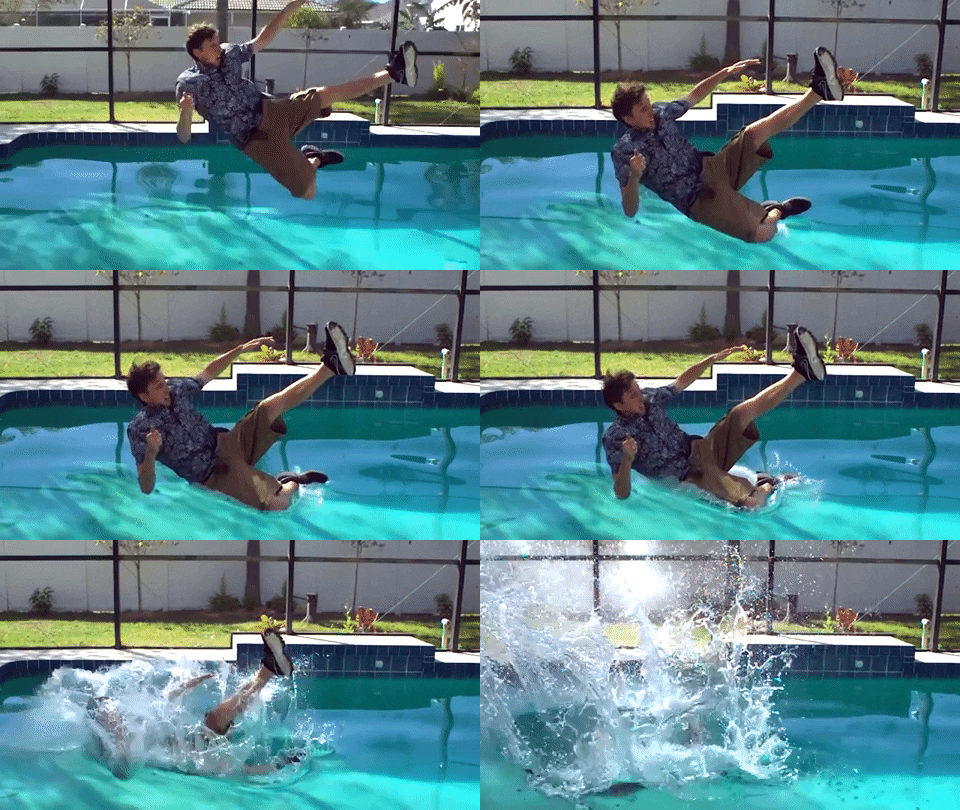
The Art of Slow Motion in Film

Slow motion is ubiquitous in modern filmmaking. It is used by a diverse range of directors to achieve diverse effects. Some classic subjects of slow motion include:

Athletic activities of all kinds, to demonstrate skill and style.
To recapture a key moment in an athletic game, typically shown as a replay.
Natural phenomena, such as a drop of water hitting a glass.
Slow motion can also be used for artistic effect, to create a romantic or suspenseful aura or to stress a moment in time.

Ardeche & Gard


A cult film or cult movie, also commonly referred to as a cult classic, is a film that has acquired a cult following. Cult films are known for their dedicated, passionate fanbase, an elaborate subculture that engage in repeated viewings, quoting dialogue, and audience participation. Inclusive definitions allow for major studio productions, especially box office bombs, while exclusive definitions focus more on obscure, transgressive films shunned by the mainstream. The difficulty in defining the term and subjectivity of what qualifies as a cult film mirror classificatory disputes about art. The term cult film itself was first used in the 1970s to describe the culture that surrounded underground films and midnight movies, though cult was in common use in film analysis for decades prior to that.