A still life is a work of art depicting mostly inanimate subject matter, typically commonplace objects which may be either natural (food, flowers, dead animals, plants, rocks, or shells) or man-made (drinking glasses, books, vases, jewelry, coins, pipes, and so on). With origins in the Middle Ages and Ancient Graeco-Roman art, still-life painting emerged as a distinct genre and professional specialization in Western painting by the late 16th century, and has remained significant since then. Still life gives the artist more freedom in the arrangement of elements within a composition than do paintings of other types of subjects such as landscape or portraiture. Early still-life paintings, particularly before 1700, often contained religious and allegorical symbolism relating to the objects depicted. Some modern still life breaks the two-dimensional barrier and employs three-dimensional mixed media, and uses found objects, photography, computer graphics, as well as video and sound
19 dec 2016
Picasso's Guernica
A still life is a work of art depicting mostly inanimate subject matter, typically commonplace objects which may be either natural (food, flowers, dead animals, plants, rocks, or shells) or man-made (drinking glasses, books, vases, jewelry, coins, pipes, and so on). With origins in the Middle Ages and Ancient Graeco-Roman art, still-life painting emerged as a distinct genre and professional specialization in Western painting by the late 16th century, and has remained significant since then. Still life gives the artist more freedom in the arrangement of elements within a composition than do paintings of other types of subjects such as landscape or portraiture. Early still-life paintings, particularly before 1700, often contained religious and allegorical symbolism relating to the objects depicted. Some modern still life breaks the two-dimensional barrier and employs three-dimensional mixed media, and uses found objects, photography, computer graphics, as well as video and sound
Amsterdam as filmlocation
>
A filming location is a place where some or all of a film or television series is produced, in addition to or instead of using sets constructed on a movie studio backlot or soundstage. In filmmaking, a location is any place where a film crew will be filming actors and recording their dialog. A location where dialog is not recorded may be considered as a second unit photography site. Filmmakers often choose to shoot on location because they believe that greater realism can be achieved in a "real" place; however, location shooting is often motivated by the film's budget. Many films shoot interior scenes on a sound stage and exterior scenes on location.
It is often mistakenly believed that filming "on location" takes place in the actual location in which its story is set, but this is not necessarily the case.
16 dec 2016
Capital of Norway: Oslo
A film treatment (or simply treatment) is a piece of prose, typically the step between scene cards (index cards) and the first draft of a screenplay for a motion picture, television program, or radio play. It is generally longer and more detailed than an outline (or one-page synopsis), and it may include details of directorial style that an outline omits. Treatments read like a short story, but are told in the present tense and describe events as they happen.
9 dec 2016
Crystals
CRYSTAL can be experienced in Eindhoven. The permanent artwork consists out of hundreds of LED-crystals which brighten when people touch them. Designer Daan Roosegaarde calls them “Lego from Mars”. The name refers not only to its futuristic design, but also to its endless potential to play.
The Crystals are placed in a black tunnel at the Natlab, the place where Einstein once worked, where Philips produced its lightbulbs, and the first CD was presented.
7 dec 2016
I Daniel Blake
A 59 year old carpenter recovering from a heart attack, befriends a single mum and her two kids as they navigate their way through the kafkaesque impersonal benefits system. With equal amounts of humour, warmth and despair. Heartfelt and emotional until the end
I, Daniel Blake is a 2016 British-French drama film directed by Ken Loach and written by Loach's frequent collaborator Paul Laverty. The film stars Dave Johns, Hayley Squires, Dylan McKiernan, and Briana Shann.
It won the Prix du public at the 2016 WAMA film festival in Poland.
It won the Palme d'Or at the 2016 Cannes Film Festival l.
6 dec 2016
Frame by Frame
When the Taliban ruled Afghanistan, taking a photo was a crime. After the regime fell from power in 2001, a fledgling free press emerged and a photography revolution was born. Now, as foreign troops and media withdraw, Afghanistan is left to stand on its own, and so are its journalists. Set in a modern Afghanistan bursting with color and character, FRAME BY FRAME follows four Afghan photojournalists as they navigate an emerging and dangerous media landscape – reframing Afghanistan for the world, and for themselves. Through cinema verite, intimate interviews, powerful photojournalism, and never-before-seen archival footage shot in secret during the Taliban regime, the film connects audiences with four humans in the pursuit of the truth.
Dutch Dark Chapter
Early documentary films, originally called "actuality films", lasted one minute or less. Over time, documentaries have evolved to become longer in length, and to include more categories; some examples being: educational, observational, and docufiction. Documentaries are very informative and are often used within schools, as a resource to teach various principles. Social-media platforms (such as YouTube) have provided an avenue for the growth of the documentary-film genre. These platforms have increased the distribution area and ease-of-accessibility; thereby enhancing the ability to educate a larger volume of viewers, and broadening the reach of persons who receive that information.
5 dec 2016
VR-movie theatre
Most 2016-era virtual realities are displayed either on a computer monitor, a projector screen, or with a virtual reality headset (also called head-mounted display or HMD). HMDs typically take the form of head-mounted goggles with a screen in front of the eyes. Some simulations include additional sensory information and provide sounds through speakers or headphones. Virtual Reality actually brings the user into the digital world by cutting off outside stimuli. In this way user is solely focusing on the digital content.
Virtual reality environment can be captured using 360° stereoscopic spherical video and 360x360 surround sound from professional VR video cameras. The users can emerge in the virtual reality environment using head-mounted displays.
2 dec 2016
Im Memoriam : Manuel
Manuel is a fictional character from the BBC sitcom Fawlty Towers. Played by Andrew Sachs, he is one of the most iconic characters in British comedy history. He reappeared for a small sketch with John Cleese in We Are Most Amused in November 2008.
Manuel himself appeared on the audio adaptations of Fawlty Towers as a linking narrator, explaining things from his point of view, when the series was released in audio format. The first two episodes released did not feature him at all, as the dialogue was edited and short burst of piano music would indicate a change of scene. However, when the whole series was re-released, they were re-edited with Manuel's linking commentary.
Loving Vincent
The art form of film is different from painting. Painting is one particular moment in time, frozen. Film is fluid, seeming to move through space and time. So first we had a Painting Design team spent one-year re-imagining Vincent’s painting into the medium of film. These paintings along with the storyboard and Computer Generated Layout Animatic formed the basis on which to plan our live action shoot.
All the characters in Loving Vincent are performed by real actors either on specially constructed sets, designed to look like Vincent’s paintings, or against Green Screens with the Loving Vincent Design Paintings composited in through a live view system on the set.
The live action material was then combined with Computer Animation for elements such as birds, horses, clouds and blowing leaves and composited together with the Design Paintings to create the Reference Material for the Painting Animation.
1 dec 2016
A Pretty Dutch Town
Film from the collection of Cinema Museum (London), restored by EYE Filmmuseum.
30 nov 2016
Evidence: the film
EVIDENCE
Evidence is an 8 minute 35mm film authored by Godfrey Reggio, during his term as director of Fabrica - a new school founded by Benetton - and a student collaborator, Angela Melitopulos. the film was shot in Rome during March 1995 and edited by Miroslav Janek, a collaborator of Fabrica, with music by composer Philip Glass.
Evidence looks into the eyes of children watching television - in this case Walt Disney’s "Dumbo". Though engaged in a daily routine, they appear drugged, retarded, like the patients of a mental hospital. Evidence is about the behavior of children watching television - an activity whose physiological aspects have been overlooked in the current controversy surrounding television.
27 nov 2016
Video as Evidence
The Video as Evidence Field Guide provides basic and advanced practices activists can use to increase the likelihood that their footage can serve as evidence in criminal and civil justice processes, for advocacy, and by the media. It also aims to help activists and lawyers better collaborate on capturing and collecting valuable video evidence.
Download the guide for free at http://vae.witness.org/
Usage of metadata
French avant garde
The avant-garde are people or works that are experimental, radical, or unorthodox, with respect to art, culture, and society. It may be characterized by nontraditional, aesthetic innovation and initial unacceptability, and it may offer a critique of the relationship between producer and consumer.
The avant-garde pushes the boundaries of what is accepted as the norm or the status quo, primarily in the cultural realm. The avant-garde is considered by some to be a hallmark of modernism, as distinct from postmodernism.
25 nov 2016
Early stop motion
Stop motion (hyphenated stop-motion when used as an adjective) is an animation technique that physically manipulates an object so that it appears to move on its own. The object is moved in small increments between individually photographed frames, creating the illusion of movement when the series of frames is played as a fast sequence. Dolls with movable joints or clay figures are often used in stop motion for their ease of repositioning. Stop motion animation using plasticine is called clay animation or "clay-mation". Not all stop motion requires figures or models; many stop motion films can involve using humans, household appliances and other things for comedic effect. Stop motion using objects is sometimes referred to as object animation.
24 nov 2016
Colored stencil film
Each frame of an extra print of the black-and-white film to be colored was rear-projected onto a sheet of
frosted glass, as in rotoscoping. An operator used a blunt stylus to trace the outlines of areas of the projected image that were to be tinted one particular color. The stylus was connected to a reducing pantograph that caused a sharp blade to cut corresponding outlines through the actual film frame, creating the stencil for that color in that frame. This had to be done for each individual frame, and as many different stencil films had to be made as there were different colors to be added. Each of the final projection prints was matched up with one of the stencil films and run through a machine that applied the corresponding dye through the stencil. This operation was repeated using each of the different stencils and dyes in turn.
23 nov 2016
Dutch Cinema Trailer - The Curious World of Hieronymus Bosch
When a new film is made, it has to be advertised like any other new product, to let people know it exists and to encourage them to go to the cinema to see it.
The advertising of a film is known as film promotion or film marketing and the people who are responsible for this are the distribution company, so–called because they distribute (give out) the films to the cinemas and distribute the promotional material around the country.
The way in which a film is promoted can have a huge effect on whether or not it is successful. Films are expensive to make and if the public do not buy tickets at the box office to see the film, a lot of money will be lost.
22 nov 2016
It's all about Sensation
Crash is a 1996 British-Canadian psychological thriller film written and directed by David Cronenberg based on J. G. Ballard's 1973 novel of the same name. It tells the story of a group of people who take sexual pleasure from car crashes, a notable form of paraphilia.
The film generated considerable controversy upon its release and opened to mixed and highly divergent reactions from critics. While some praised the film for its daring premise and originality, others criticized its combination of graphic sexuality and violence. It premiered at the Cannes Film Festival, where it won the Special Jury Prize, considered the third-most prestigious prize of the festival.
As a photographic print is the positive made from its negative, so also the positive of self-crashing is arranging for a disaster to occur on the highway, and then watching the carnage from a preselected observation post. Disasters other than on the highway may be arranged — catastrophic fires, for example. For those members of the general public who have a touch of sadomasochism in them, disaster as an unrehearsed event is often a large part of the appeal of entertainment stunts and sports, from the circus to stock-car racing.
21 nov 2016
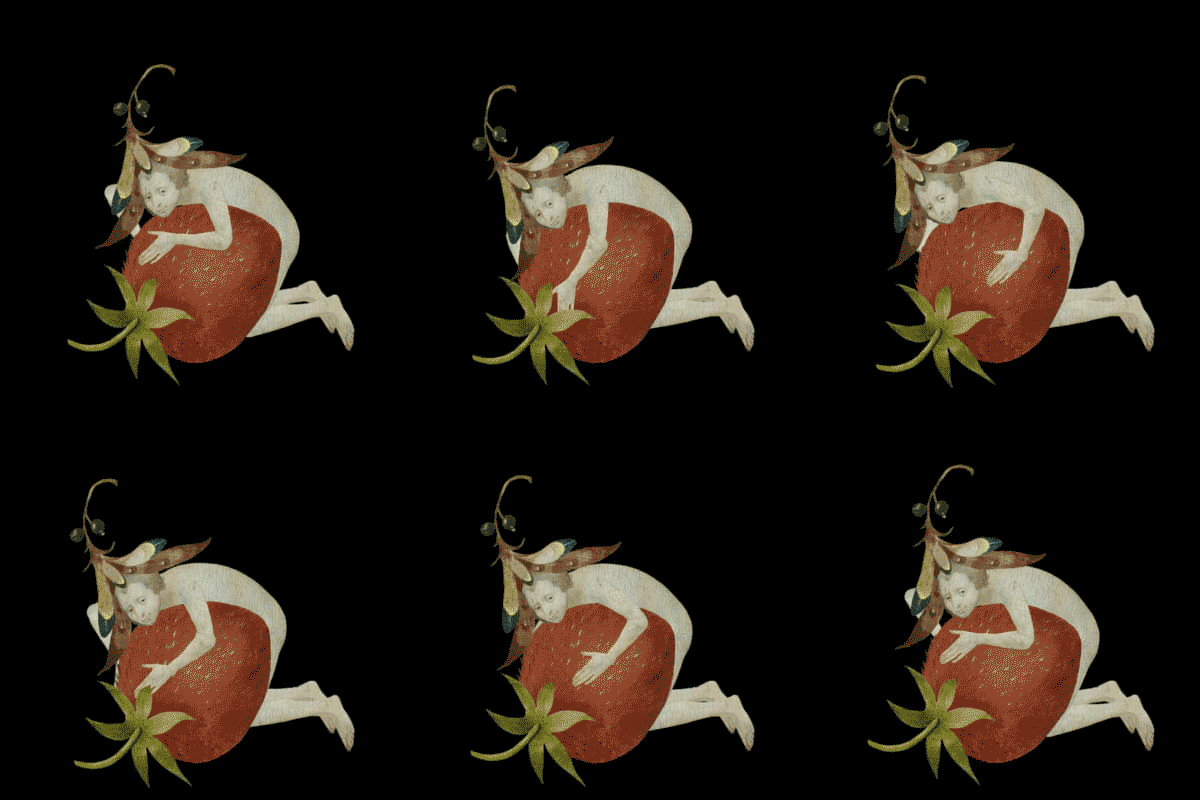
Garden of Earthly Delights
Here’s how the Dutch animators behind this project explain what’s unfolding before your eyes:
[We] cleared the original landscape of the middle panel of Bosch’s painting and reconstructed it into a hallucinatory 4K animation. The creatures that populate this indoor playground embody the excesses and desires of 21st century Western civilization. Consumerism, selfishness, escapism, the lure of eroticism, vanity and decadence. All characters are metaphors for our society where loners swarm their digital dream world. They are symbolic reflections of egos and an imagination of people as they see themselves – unlike Bosch’s version, where all individuals more or less look the same. From a horny Hello Kitty to a coke hunting penis snake. From an incarnate spybot to headless fried chickens. These characters, once precisely painted dream figures, are now digitally created 3D models. All of them have been given their own animation loop to wander through the landscape. By placing them altogether in this synthetic fresco, the picture is never the same. What the animation and Bosch’s triptych have in common is that you’ll hardly be able to take it all in, you can watch it for hours.